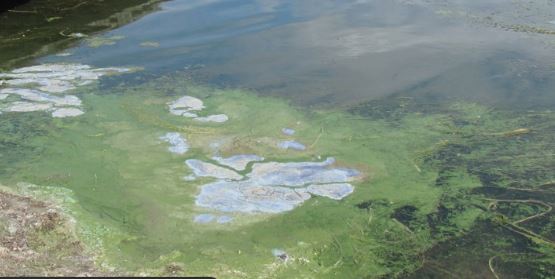
Micro-nanobubbles (MNBs) offer a powerful, chemical-free, and physical solution for remediating blue-green algae blooms (Cyanobacteria) in lakes and ponds. Unlike traditional surface aeration or harsh algaecides, MNB technology targets the root environmental triggers of blooms while simultaneously destroying the cells.
MNBs have an exceptionally high surface-area-to-volume ratio and remain suspended in water for weeks due to their near-neutral buoyancy and negligible rising velocity.
As they slowly dissolve, they maintain a high, uniform Dissolved Oxygen (DO) profile throughout the water column—from surface to sediment.
When micro-nanobubbles collapse (implode), they generate high localized temperatures and pressures, producing reactive oxygen species such as hydroxyl radicals.These radicals act as powerful natural oxidizers that rupture the cell walls and gas vesicles of cyanobacteria without harming fish or zooplankton.
.png)
Blue-green algae rely on internal gas vacuoles to float to the surface and form dense scats to capture sunlight. The physical and oxidative action of MNBs compromises these gas vesicles, causing the algae to lose buoyancy and sink to the bottom where they decompose safely without access to sunlight.
.png)
In anoxic (oxygen-depleted) bottom sediments, phosphorus (bound to iron) is released into the water column, fueling explosive algae growth.
By oxygenating the sediment-water interface, MNBs oxidize iron into ferric iron Fe3+, which strongly binds with phosphorus, locking it in the sediment and starving the algae of nutrients.
.png)
High oxygen levels supercharge the populations of beneficial aerobic heterotrophic bacteria. These bacteria consume excess organic carbon and nitrogen, outcompeting algae for available resources.
.png)
| Feature | Micro-Nanobubbles | Chemical Algaecides (e.g., Copper Sulfate) | Traditional Surface Fountains/Aerators |
| Environmental Impact | Eco-friendly; zero chemical toxicity. | Can be toxic to fish, macroinvertebrates, and beneficial plants. | Safe, but limited radius of influence. |
| Duration of Effect | Long-term ecological recovery (prevents recurrence). | Short-term band-aid; requires repeated dosing. | Moderate; only treats localized surface layers. |
| Sediment Impact | Reduces muck and oxidizes bottom sludge. | Accumulates dead organic matter, worsening bottom anoxia over time | Limited deep-water oxygenation capacity. |
https://pubmed.ncbi.nlm.nih.gov/39366442/
https://www.sciencedirect.com/science/article/pii/S0301479724033929?via%3Dihub
https://www.sciencedirect.com/science/article/abs/pii/S004896972030276X?via%3Dihub
https://www.tandfonline.com/doi/full/10.1080/01919512.2022.2052013