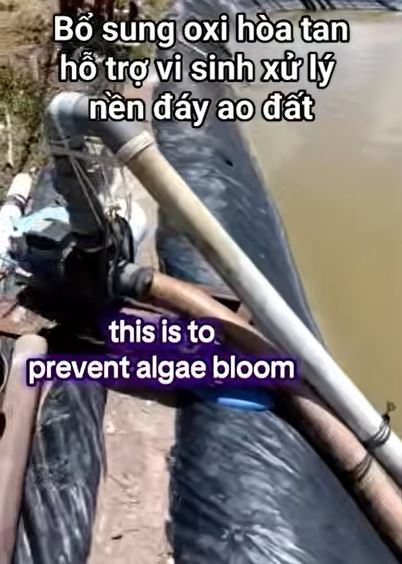
https://youtube.com/shorts/pPTWUDRqb2Y
In a traditional soil-lined fish pond, managing water quality and the pond bottom (the soil interface) is a constant battle.
High density, organic waste accumulation, and low oxygen levels at the bottom often lead to toxic gas buildup and fish stress.
Fine bubbles (specifically micro-bubbles and nano-bubbles) fundamentally change this dynamic.
Unlike coarse bubbles from standard paddlewheels or diffusers that rapidly rise and burst, fine bubbles
behave more like a liquid solution, providing unique physical and biological benefits to a soil pond ecosystem.
Here is a detailed breakdown of how fine bubbles help:
In standard soil ponds, water stratifies: the top layer is warm and oxygen-rich (thanks to sunlight and algae),
while the bottom layer is cold, stagnant, and oxygen-depleted.
The Fine Bubble Difference: Because micro-nano bubbles are incredibly small, they have a negligible
rising velocity. Instead of shooting straight to the surface, they remain suspended in the water column for days,
moving randomly via Brownian motion.
The Result: This ensures that dissolved oxygen (DO) is distributed evenly throughout the entire depth
of the pond, completely eliminating the hypoxic "dead zone" at the bottom where fish often feed and rest.
The soil at the bottom of a fish pond accumulates feces, uneaten feed, and dead algae, turning into a thick,
anaerobic (oxygen-poor) sludge. Under anaerobic conditions, bacteria produce highly toxic gasses like
Hydrogen Sulfide (H2S), Ammonia (NH3), and Methane (CH4).
Oxygenating the Soil Interface: Because fine bubbles hover right above and penetrate the upper
layer of the soil sediment, they shift the pond bottom from an anaerobic environment to an aerobic one.
Accelerating Decomposition: Aerobic bacteria work up to 20 times faster than anaerobic
bacteria. With a constant supply of oxygen from fine bubbles, these beneficial bacteria rapidly digest organic sludge, preventing the buildup of black, foul-smelling mud.
Locking in Toxins: In an oxygen-rich environment, chemical reactions change. For example,
toxic H2S is oxidized into harmless sulfates, and phosphorus binds to the soil iron rather than dissolving into the water to trigger toxic algae blooms.
Ammonia excretion from fish is a major bottleneck in aquaculture. In a soil pond, the nitrification process
(converting toxic ammonia into nitrite, and then into harmless nitrate) happens largely via biofilm on the pond soil and suspended particles.
Boosting Nitrosomonas and Nitrobacter: The bacteria responsible for this cleanup are obligate aerobes
—they require massive amounts of oxygen to function.
Enhanced Biofloc/Probiotic Performance: Fine bubbles provide the perfect, ultra-oxygenated
environment for these beneficial nitrating bacteria to thrive, resulting in a dramatic drop in total ammonia nitrogen (TAN) and
nitrite (NO2) levels.
Lower Stress, Better FCR: When DO levels are consistently high and stable (no drastic dips at 3:00 AM),
fish experience zero respiratory stress. This significantly improves their Feed Conversion Ratio (FCR)—
they convert feed into body mass much more efficiently instead of wasting energy just trying to breathe.
Natural Pathogen Suppression: Many harmful aquatic pathogens (like certain strains of Vibrio
or anaerobic fungi) thrive in low-oxygen, high-organic-waste environments. Maintaining an oxygen-rich
soil-water interface naturally suppresses these pathogens, reducing disease outbreaks and mortality rates.
Endogenous Radical Generation: As micro-bubbles shrink and collapse under water pressure,
they naturally generate trace amounts of hydroxyl radicals (-OH). This micro-ozonization effect helps mildly
disinfect the water and break down complex organic compounds without harming the fish.
In short, while traditional aerators simply try to keep the fish at the surface alive, fine bubble technology targets
the soil-water interface, turning the pond bottom from a toxic liability into an active biological filter.
Tags: