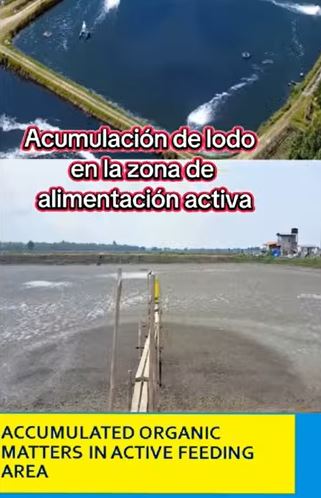
https://youtube.com/shorts/mJ21xWShci8
Fine bubbles can significantly improve the condition of the pond bottom, particularly around automatic feeders where shrimp tend to congregate and uneaten feed and feces accumulate. Their benefits arise from improved oxygen transfer, enhanced water circulation, and stimulation of beneficial microbial activity.
Why sludge accumulates around automatic feeders
In intensive shrimp ponds, the area around an auto-feeder often becomes a "hot spot" because:
* Shrimp spend more time feeding in this area.
* Uneaten feed settles on the pond bottom.
* Shrimp feces accumulate rapidly.
* Oxygen demand increases due to microbial decomposition.
* Anaerobic zones can develop, producing toxic compounds such as:
* Ammonia (NH₃)
* Hydrogen sulfide (H₂S)
* Methane (CH₄)
These conditions increase stress, reduce feed conversion efficiency, and elevate the risk of diseases caused by opportunistic bacteria such as Vibrio spp.
How fine bubbles improve bottom sludge treatment
1. Increase dissolved oxygen directly at the pond bottom
Unlike paddlewheel aerators, which mainly oxygenate the surface layer, fine bubbles can be discharged close to the pond bottom.
Benefits include:
* Higher DO concentration in the sludge layer
* Reduced formation of anaerobic zones
* Faster aerobic decomposition of organic matter
* Lower oxygen debt around feeding areas
Result:
* Less black sludge
* Less foul odor
* Reduced toxic gas production
2. Stimulate beneficial aerobic bacteria
Aerobic bacteria require oxygen to degrade:
* Feed residues
* Shrimp feces
* Dissolved organic carbon (DOC)
Higher oxygen availability promotes bacteria such as:
* Bacillus spp.
* Nitrosomonas
* Nitrobacter
These microorganisms convert organic waste into harmless products more efficiently.
Benefits include:
* Faster sludge mineralization
* Reduced organic loading
* Improved water clarity
* Lower biological oxygen demand (BOD)
3. Prevent formation of hydrogen sulfide
When oxygen is depleted, sulfate-reducing bacteria become active and produce H₂S.
Fine bubbles help by:
* Maintaining aerobic conditions
* Suppressing sulfate-reducing bacteria
* Preventing black anaerobic sediment
This protects shrimp from chronic H₂S exposure, which can damage the gills and reduce growth.
4. Improve water circulation near the bottom
As fine bubbles rise, they create localized upward water movement.
This circulation:
* Prevents localized sludge accumulation
* Suspends fine organic particles
* Carries suspended solids toward the pond center or drainage area
* Improves mixing around the feeder
When combined with central drainage, sludge removal becomes much more efficient.
5. Enhance oxidation of reduced compounds
Fine bubbles increase the oxidation rate of compounds such as:
* NH₄⁺ → NO₂⁻ → NO₃⁻
* Fe²⁺ → Fe³⁺
* Mn²⁺ → MnO₂
This improves overall sediment quality and water chemistry.
How fine bubbles improve shrimp gathering around the feeder
1. Create an oxygen-rich feeding zone
Shrimp naturally prefer areas with:
* Higher dissolved oxygen
* Better water quality
* Lower toxic metabolites
Fine bubbles can increase DO near the feeding area by 1–2 mg/L compared with poorly aerated zones (depending on system design and stocking density).
This encourages:
* More active feeding
* Longer feeding periods
* Reduced crowding stress
2. Increase shrimp appetite
Higher oxygen supports:
* Better metabolism
* Faster digestion
* Higher feed intake
* Improved feed conversion ratio (FCR)
Shrimp become more active during feeding, particularly at night when oxygen demand is highest.
3. Reduce stress during feeding
Accumulated sludge releases:
* H₂S
* NH₃
* Organic acids
These irritate shrimp and can cause them to avoid the feeding area.
Cleaner bottom conditions encourage shrimp to remain near the feeder and consume feed more uniformly.
4. Reduce pathogenic bacteria
Fine bubbles themselves do not disinfect the pond, but by:
* lowering organic waste,
* improving oxygenation, and
* supporting beneficial microbial communities,
they make conditions less favorable for opportunistic pathogens such as Vibrio spp.
5. Improve feed utilization
A clean feeding area means:
* less feed buried in sludge,
* reduced nutrient loss,
* easier access to pellets.
This can improve FCR and reduce feed waste.
Best installation practices
For maximum effectiveness:
* Install fine bubble nozzles approximately 30–40 cm above the pond bottom around the automatic feeder.
* Avoid excessive turbulence directly beneath the feeder, as this can disperse feed before shrimp consume it.
* Combine fine bubbles with a paddlewheel or directional aeration system to maintain overall pond circulation and transport suspended solids toward the central collection area.