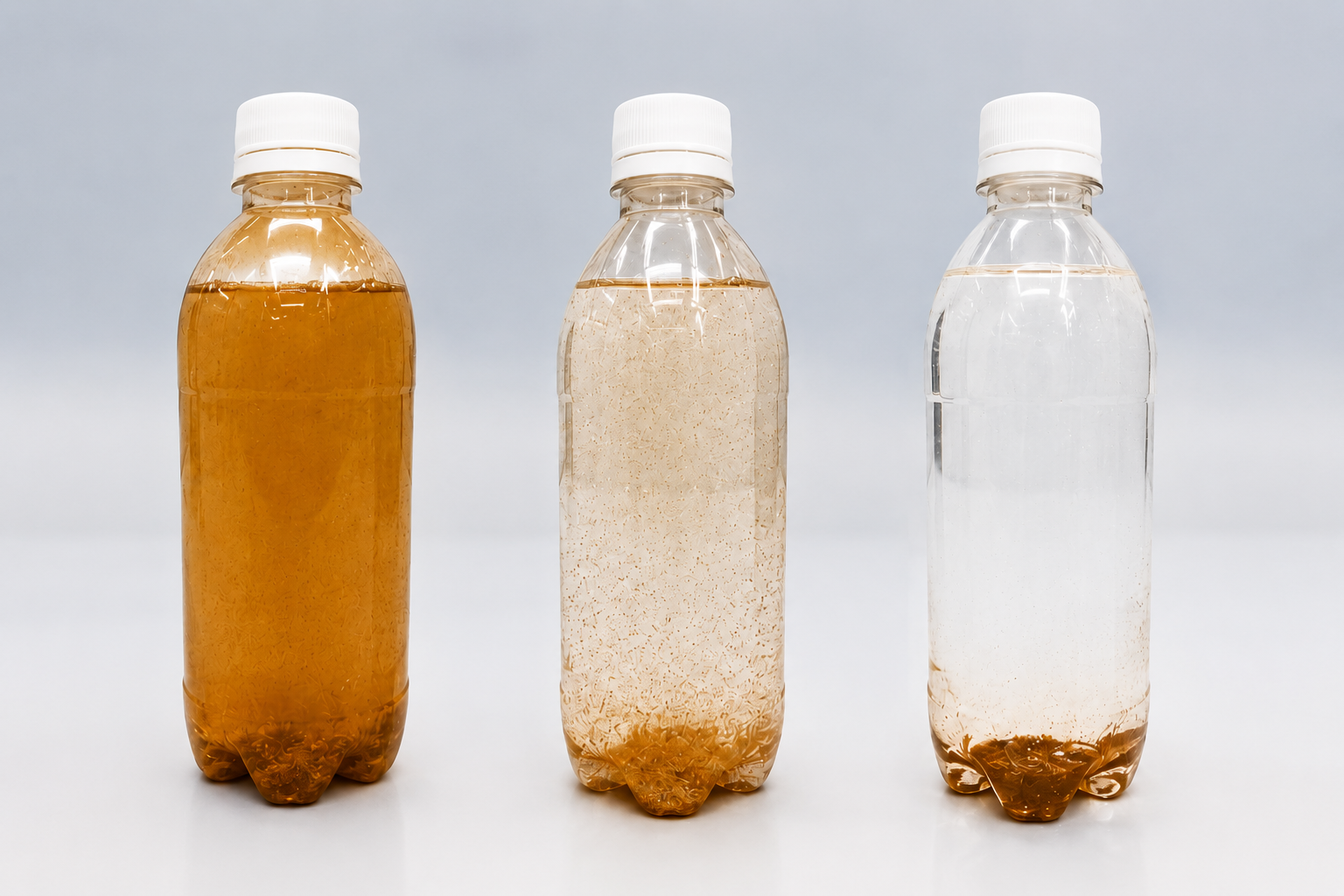
Fine bubbles improve oxidization and precipitation of ferrous sulphate in groundwater
Fine bubble aeration (typically 50–500 µm bubbles) can be an effective method for oxidizing dissolved ferrous iron (Fe²⁺) in groundwater, allowing it to precipitate as insoluble ferric hydroxide that can then be removed by sedimentation or filtration. If your groundwater contains iron sulfate (ferrous sulfate, FeSO₄), the sulfate itself is generally not removed by aeration, but the ferrous iron component is oxidized and precipitated, while sulfate remains dissolved.
1. The principle
Groundwater often contains iron in the soluble ferrous form because it is oxygen-poor.
When fine bubbles introduce oxygen:
1. Oxygen dissolves rapidly into the water.
2. Ferrous iron (Fe²⁺) is oxidized into ferric iron (Fe³⁺).
3. Ferric iron hydrolyzes and forms insoluble ferric hydroxide.
4. Ferric hydroxide particles grow into flocs.
5. The flocs are removed by settling or filtration.
The overall reaction is approximately:
4 Fe{2+} + O2 + 10 H2O into 4 Fe(OH)3 + 8H+
2. Why fine bubbles work better than coarse bubbles
a) Much higher oxygen transfer efficiency
Fine bubbles provide:
* enormous gas-liquid surface area
* longer residence time
* slower rise velocity
This results in:
* faster dissolved oxygen increase
* more complete iron oxidation
* lower blower energy for the same oxygen transfer
b) Better mixing
Fine bubbles create gentle circulation throughout the water column.
This helps:
* distribute oxygen evenly
* expose all dissolved iron to oxygen
* reduce stagnant zones
c) More oxidation sites
Every bubble surface acts as a gas-liquid interface.
Millions of bubbles provide millions of reaction sites where oxygen dissolves continuously.
3. Iron oxidation rate
Oxidation depends strongly on:
* dissolved oxygen
* pH
* temperature
* alkalinity
Groundwater treatment often adjusts pH to around 7.2–8.0 if rapid iron removal is desired.
4. Bubble-induced floc formation
Fine bubbles also assist precipitation by:
* gently mixing particles
* increasing particle collisions
* promoting growth of ferric hydroxide flocs
Larger flocs settle more easily.
5. Increased filtration efficiency
Without adequate oxidation:
* dissolved iron passes through many filters.
With fine bubble oxidation:
* iron becomes particulate.
* sand filters capture it effectively.
* multimedia filters perform better.
* cartridge filters last longer.
6. Reduced chemical consumption
Many treatment plants use oxidants such as:
* chlorine
* potassium permanganate
* ozone
* hydrogen peroxide
Fine bubble aeration may:
* eliminate chemicals for low-to-moderate iron concentrations
* reduce oxidant dosage when chemicals are still needed
This lowers operating costs and avoids introducing unwanted chemical residuals.
7. Simultaneous removal of other dissolved gases
Fine bubbles also strip gases from groundwater, including:
* carbon dioxide (to some extent)
* hydrogen sulfide (H₂S)
* methane
Removing H₂S reduces odor and prevents competition for oxygen during iron oxidation.
8. What happens to sulfate?
This is important.
Fine bubbles do not remove sulfate (SO₄²⁻).
Instead:
* Fe²⁺ precipitates.
* SO₄²⁻ remains dissolved.
Therefore:
* iron concentration decreases
* sulfate concentration remains essentially unchanged
If sulfate reduction is required, processes such as reverse osmosis, ion exchange, or biological sulfate reduction are typically needed.
9. Additional advantages of fine bubbles
Besides iron oxidation, fine bubble aeration can:
* Increase dissolved oxygen to near saturation.
* Oxidize dissolved manganese (more slowly than iron, often requiring higher pH or stronger oxidants).
* Improve water clarity through better particle aggregation.
* Reduce odors by stripping volatile compounds and oxidizing reduced species.
* Improve biological filtration performance if the water is subsequently treated in biofilters.
* Lower blower power requirements compared with coarse-bubble systems for the same oxygen transfer.
Tags: