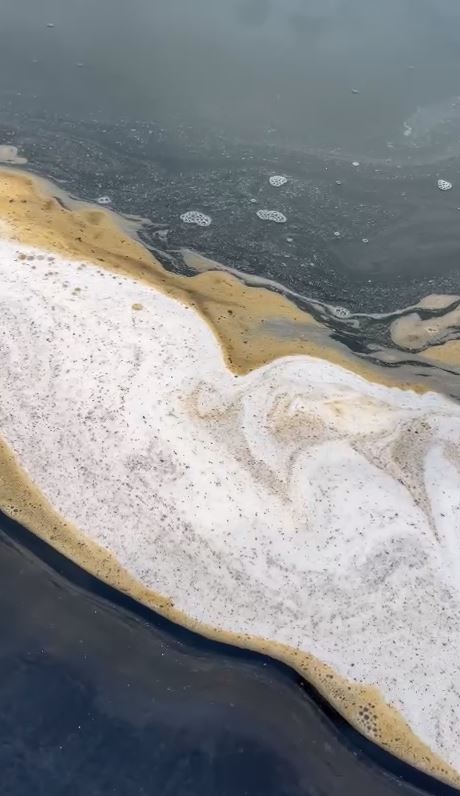
Fine bubbles (especially microbubbles, 10–100 µm) can be very effective in treating brackish groundwater or well water containing high dissolved ferrous iron (Fe²⁺) before it is used in intensive shrimp farming. Their primary role is to accelerate iron oxidation and improve iron removal, rather than directly removing dissolved iron by themselves.
How iron exists in brackish water
Iron is usually present in two forms:
* Ferrous iron (Fe²⁺) – dissolved, colorless, stable in oxygen-poor groundwater
* Ferric iron (Fe³⁺) – insoluble iron hydroxide particles (rust-colored flocs)
Shrimp farms typically pump groundwater rich in Fe²⁺. Once exposed to oxygen:
4Fe(2+) +O2 +10H2O converted to 4Fe(OH)3 + 8H+
Ferric hydroxide then precipitates and can be removed by settling or filtration.
Why fine bubbles are better than conventional aeration
1. Higher oxygen transfer efficiency
Fine bubbles provide:
* Very high gas-liquid surface area
* Longer residence time
* Higher oxygen dissolution efficiency
Compared with coarse bubbles, they can oxidize Fe²⁺ much faster because oxygen is supplied more efficiently.
Example:
* Coarse bubble aerator: 15–25% oxygen transfer
* Fine bubble diffuser: 35–60%
* Microbubble generator: often even higher depending on design
This means oxidation can occur in a smaller treatment tank.
2. Much larger contact area
A single 1-mm bubble has relatively little surface area.
One million 50-µm bubbles have:
* enormously larger total surface area
* far greater oxygen-water contact
This greatly accelerates oxidation kinetics.
3. Longer bubble residence time
Coarse bubbles rise rapidly.
Microbubbles rise slowly, remaining suspended for several minutes.
This provides:
* more oxygen dissolution
* more complete oxidation
* less wasted air
4. Improved mixing
Fine bubbles generate gentle circulation.
Benefits include:
* uniform oxygen distribution
* elimination of stagnant zones
* uniform oxidation throughout the tank
5. Formation of larger iron flocs
After oxidation:
Fe³⁺ forms gelatinous Fe(OH)₃ particles.
Fine bubbles encourage particle collisions through gentle mixing.
Larger flocs:
* settle faster
* filter more easily
* reduce downstream filter clogging
---
Additional benefit of oxygen microbubbles
Using oxygen instead of air:
* faster oxidation
* shorter hydraulic retention time
* smaller oxidation tank
However:
For most shrimp farms,
air microbubbles are sufficient unless iron concentrations are extremely high.
Can nanobubbles help?
Nanobubbles (less than 200 nm) offer additional advantages:
* very long persistence in water
* high internal pressure
* production of small amounts of reactive oxygen species (ROS) during collapse
These effects may slightly enhance iron oxidation.
However, for iron removal:
Microbubbles generally provide the greatest practical benefit because they deliver much more oxygen and better mixing.
A practical treatment system could include:
1. Fine bubble oxidation tank
* 20–40 minutes retention
* DO maintained above 5–6 mg/L
2. Lamella clarifier or settling tank
3. Multimedia sand filter
4. Optional manganese greensand or catalytic media if residual iron remains
Important limitation
Fine bubbles cannot remove dissolved iron by themselves. They only convert soluble Fe²⁺ into insoluble Fe(OH)₃. Effective treatment therefore requires a complete process:
1. Oxidation (using fine bubbles)
2. Flocculation (natural or aided if needed)
3. Solid-liquid separation (settling or lamella clarification)
4. Filtration (sand or multimedia filters)
Without the settling and filtration steps, the oxidized iron particles will simply remain suspended and can still enter the shrimp ponds.