Settling tank and foam fractionator were compared in BFT systems with P. vannamei.
- A 70-L foam fractionator maintained acceptable water quality in a 30 m³ shrimp tank.
• Foam fractionator did not affect nitrification but reduced bacterial abundance.
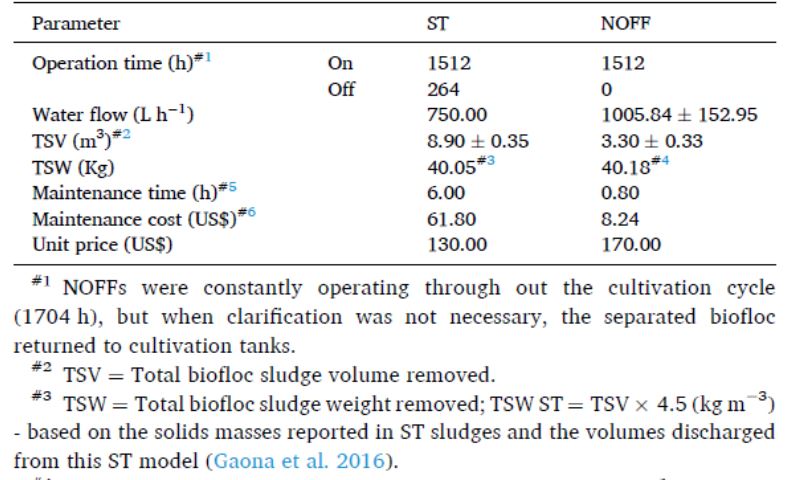
• Operation of foam fractionator resulted in 2.8-folds sludge volume reduction.
• Shrimp growth parameters did not differ between clarification treatments.
Water clarification is essential in Biofloc Technology (BFT) systems to control suspended solids, prevent gill damage in cultured species, and enable aquaponic reuse of water. Different clarification methods can affect sludge production, water consumption, biofloc characteristics, and water quality. This study compared the effects of suspended solids control by traditional settling tank (ST) and nanobubbles operating foam fractionator (NOFF) on water parameters, bacterial community and growth of the Penaeus vannamei in a super-intensive grow-out (450 shrimp m−3) with biofloc technology. A grow-out was carried out for 74 days in a greenhouse with six 35 m3 tanks, with treatments evaluated in triplicate. Settling tanks (1000 L) were activated when total suspended solids (TSS) concentration exceeded 400 mg L−1, while foam fractionators (70 L) operated continuously using nanobubbles generated by nozzle-type air injectors. Water quality remained within acceptable levels for P. vannamei with biofloc culture. Both treatments showed similar high average contents of nitrate (55.93–52.47 mg L−1), although nitrite levels were higher in ST. TSS was higher in NOFF (368.70 ± 25.17 mg L−1) than in ST treatment (301.11 ± 19.10 mg L−1), but NOFF produced 2.8-folds times smaller production of sludge volume. Metagenomic analyses and bacterial counts showed that Cyanobacteria/filamentous bacteria were very representative in NOFF treatment, but no harmful effects on shrimp growth were observed. Differences in suspended solids dynamics and bacterial community could be explained by bioflocs’ rupture and selective removal of particles/suspended organic compounds by the foam fractionation, which selectively inhibited microbial growth in water column but keep water quality in the grow-out tanks. Shrimp growth parameters were unaffected by clarification treatments.