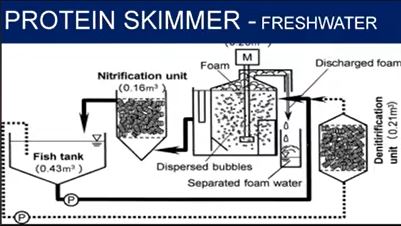
How it helps in intensive eel RAS
1. Removes dissolved and colloidal organic matter
Eels produce large amounts of:
* mucus
* fecal dissolved organics
* uneaten feed
* proteins and peptides
* bacterial metabolites
* fine suspended/colloidal particles
A skimmer transfers surface-active organic compounds onto fine air bubbles and removes them as concentrated foam.
This can reduce the organic load entering the biofilter.
2. Reduces the load on the biofilter
This is particularly important in intensive eel farming.
Without a skimmer:
Feed → eel metabolism + feces → dissolved/colloidal organics → biofilter
With a skimmer:
Feed → eel metabolism + feces → solids removal + skimmer → biofilter
The skimmer therefore acts as a pre-conditioning step before biological filtration, particularly for the fraction that a drum filter cannot capture.
3. Helps maintain clearer water
A properly operated skimmer can remove very fine particles and colloids that remain after mechanical filtration.
This can improve:
* water transparency
* filter performance
* UV effectiveness
* visual monitoring of eel health
* overall water cleanliness
For eel RAS, this is especially valuable because high feeding rates can rapidly increase fine organic particles.
4. Helps control bacterial/organic loading
Dissolved organic carbon provides substrate for heterotrophic bacteria.
Excessive organic loading can result in:
* increased bacterial growth
* higher oxygen consumption
* biofilm accumulation
* deterioration of water quality
* increased competition with nitrifying bacteria
Removing part of the organic fraction before it reaches the biofilter can therefore indirectly reduce heterotrophic oxygen demand.
5. It can provide additional aeration
A skimmer introduces a large quantity of air into the water.
Consequently, it can provide some:
*O₂ transfer + CO₂ stripping
Tags: