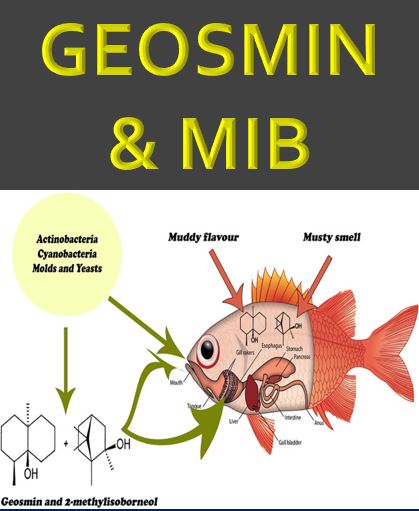
Ozone nanobubbles and a protein skimmer can complement each other to reduce geosmin and 2-methylisoborneol (2-MIB) (often incorrectly referred to as "MIB-2 bacteria"; 2-MIB is actually an odor compound, not a bacterium) in freshwater fish culture systems, particularly in RAS, broodstock tanks, live fish holding systems, and high-density ponds.
Sources of geosmin and 2-MIB
Geosmin and 2-MIB are earthy/musty odor compounds mainly produced by:
* Cyanobacteria (blue-green algae)
* Actinomycetes, particularly Streptomyces
* Some filamentous bacteria and fungi
Fish absorb these compounds through their gills and skin, causing off-flavor even when water concentrations are only a few nanograms per liter.
Role of ozone nanobubbles
1. Oxidation of geosmin and 2-MIB
Ozone is one of the strongest oxidants available for water treatment.
Benefits include:
* Breaks down geosmin molecules
* Oxidizes 2-MIB into odorless compounds
* Shortens depuration time before harvest
* Improves taste and market quality
Nanobubbles improve ozone efficiency because:
* Bubble diameter is typically less than 200 nm
* Very high gas-liquid surface area
* Nearly complete ozone dissolution
* Longer residence time than coarse bubbles
* Reduced ozone loss to the atmosphere
Compared with conventional ozone injection:
* higher ozone transfer efficiency
* lower ozone consumption
* more uniform treatment
2. Control of odor-producing microorganisms
Proper ozone dosing suppresses:
* Cyanobacteria
* Actinomycetes
* Organic biofilms
* Suspended bacterial aggregates
This reduces the production of new geosmin and 2-MIB.
3. Oxidation of dissolved organic matter (DOM)
DOM provides nutrients for odor-producing microbes.
Ozone:
* partially oxidizes humic substances
* breaks large organic molecules into smaller biodegradable compounds
* improves subsequent biofiltration
Lower organic loading generally results in fewer odor-producing microorganisms.
4. Improvement of water clarity
Ozone:
* coagulates fine colloids
* reduces yellow coloration
* improves UV penetration
* decreases suspended particles
This makes conditions less favorable for algal blooms.
Role of a protein skimmer (foam fractionator)
Protein skimmers are widely used in marine aquaculture but can also provide benefits in freshwater when sufficient surfactants or fine bubbles are present.
1. Removal of dissolved organic carbon
Protein skimmers remove:
* proteins
* amino acids
* lipids
* fine suspended organics
* bacterial exopolymers
Reducing dissolved organic carbon limits nutrients available for microbial growth.
2. Removal of bacterial flocs
Fine bubbles collect:
* bacterial aggregates
* algae fragments
* extracellular polymeric substances (EPS)
* biofilm debris
Removing these particles decreases the biomass of geosmin-producing organisms.
3. Reduction of precursors
Although protein skimmers do not directly remove dissolved geosmin efficiently (because geosmin and 2-MIB are relatively small dissolved molecules), they help by removing:
* odor-producing biomass
* organic precursors
* particulate matter that supports microbial growth
This reduces future geosmin production.
4. Improved oxygenation
When combined with air or oxygen injection, skimmers:
* increase dissolved oxygen
* improve gas exchange
* strip excess CO₂
* stabilize pH
Healthier fish metabolize and eliminate off-flavor compounds more effectively during depuration.
The sequence is important:
1. Protein skimmer removes suspended organics and concentrates foam waste.
2. Ozone nanobubbles oxidize dissolved odor compounds and remaining microorganisms.
3. Biofilter converts biodegradable oxidation products into harmless end products.
This integrated process reduces both the source of off-flavors and the compounds already present in the water.