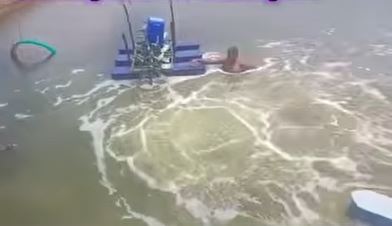
Nanobubbles can help reduce hydrogen sulfide (H₂S) in earthen shrimp ponds through several mechanisms.
The effect is usually indirect when using oxygen nanobubbles, and both direct and indirect when using ozone nanobubbles.
Why H₂S forms in shrimp ponds
Hydrogen sulfide is produced when:
* Organic sludge accumulates on the pond bottom.
* Oxygen becomes depleted in sediment.
* Sulfate-reducing bacteria convert sulfate (abundant in seawater) into H₂S under anaerobic conditions.
* Black mud layers develop in the pond bottom.
Typical reaction:
SO₄²⁻ → H₂S (under anaerobic conditions)
H₂S is highly toxic to shrimp, especially at low pH and low dissolved oxygen.
---
1. Oxygen Nanobubbles Increase Oxidation of H₂S
Oxygen nanobubbles provide a very large gas-liquid interface and remain suspended for hours to weeks.
When oxygen is supplied near the pond bottom:
H₂S + O₂ → S⁰ (elemental sulfur)
Further oxidation:
S⁰ + O₂ → SO₄²⁻
Benefits:
* Converts toxic H₂S into much less toxic sulfur compounds.
* Reduces H₂S release from sludge.
* Increases oxidation-reduction potential (ORP) of bottom water.
This is particularly important during:
* Nighttime
* Cloudy periods
* High biomass culture
---
2. Oxygen Nanobubbles Improve Sediment Oxygen Penetration
Conventional aerators mainly oxygenate the upper water column.
Nanobubbles:
* Remain dispersed throughout the pond.
* Can reach the sediment-water interface.
* Create a thin oxidized layer above the sludge.
This suppresses sulfate-reducing bacteria responsible for H₂S formation.
Result:
* Less new H₂S generated.
* Reduced black sludge development.
* Higher sediment redox potential.
---
3. Promote Beneficial Aerobic Bacteria
Higher oxygen availability favors:
* Heterotrophic degraders
* Nitrifiers
* Sulfur-oxidizing bacteria
Examples include:
* Thiobacillus
* Beggiatoa
These bacteria consume sulfide and convert it into sulfur or sulfate.
Result:
* Biological removal of H₂S.
* Reduced odor.
* Improved sediment quality.
---
4. Reduction of Organic Sludge Accumulation
One of the root causes of H₂S is excessive organic matter:
* Uneaten feed
* Feces
* Dead plankton
Nanobubble oxygenation accelerates aerobic decomposition:
Organic matter + O₂ → CO₂ + H₂O
instead of:
Organic matter → Organic acids → H₂S + CH₄
Result:
* Less sludge accumulation.
* Lower sulfide production potential.
---
5. Ozone Nanobubbles Are Even More Effective
Ozone directly oxidizes hydrogen sulfide.
Reaction:
H₂S + O₃ → SO₄²⁻ + H₂O
Advantages:
* Extremely fast oxidation.
* Immediate odor reduction.
* Can break down dissolved organic matter that fuels H₂S formation.
However, for shrimp ponds:
* Ozone should usually be applied in side-stream treatment systems.
* Residual ozone entering the culture area can damage shrimp gills and beneficial microbes.
6. Increased ORP Suppresses Sulfide Formation
Many shrimp farms observe H₂S problems when bottom ORP falls below approximately:
-100 to -200 mV
Nanobubbles can increase ORP by:
* Improving oxygen availability.
* Generating small amounts of reactive oxygen species during bubble collapse.
* Enhancing aerobic microbial activity.
Higher ORP generally means:
* Less sulfate reduction.
* Less H₂S generation.