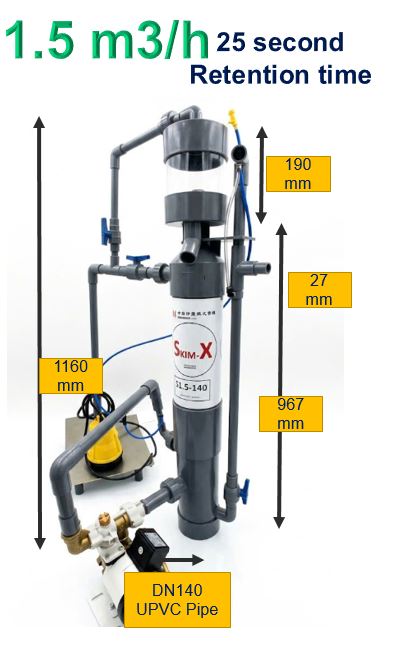
A counter-current protein skimmer (CPS) can be highly beneficial in both saltwater and freshwater RAS, particularly when the system has high stocking density and high feeding rates. Its main function is to remove dissolved and colloidal organic matter before these compounds are further degraded into ammonia and other nitrogenous waste.
In a counter-current skimmer, water flows downward while air bubbles rise upward. This creates prolonged contact between the bubbles and water.
The main advantages are:
* Longer gas–water contact time
* Better opportunity for organic molecules to attach to bubbles
* High foam concentration at the top of the column
* Good performance with relatively compact equipment
* Suitable for continuous operation
* Can work particularly well with fine/microbubble generation
A simplified process is:
*RAS water → counter-current skimmer → foam/waste removal → cleaner water → biofilter/degassing/oxygenation → culture tank
Saltwater vs. freshwater
Saltwater RAS
* Generally the most favorable environment for protein skimming because seawater produces stable foam more readily.
* Particularly useful for marine fish, shrimp, grouper, barramundi and marine broodstock systems.
* Can substantially reduce DOC and fine organic loading.
Freshwater RAS
* Protein skimming is still useful, but foam stability is normally lower than in seawater.
* Performance can be improved using an efficient fine-bubble generator and appropriate skimmer geometry.
* Particularly interesting for high-density eel, tilapia, trout and other intensive freshwater systems where feed input and organic loading are high.
An important point for high-density RAS
For intensive aquaculture, a counter-current protein skimmer is considered as a polishing/pre-treatment component rather than a replacement for the biofilter.
A strong treatment train can be:
*Mechanical filtration → Counter-current protein skimmer → Biofilter → Degassing → Oxygenation → UV/ozone (if required) → Fish tank
The skimmer is especially valuable before the biofilter, because removing organic material early can reduce the competition between heterotrophic bacteria and nitrifying bacteria.
For eel RAS or other very high-density systems, combining a counter-current protein skimmer + fine-bubble/oxygenation system + mechanical solids filtration can be particularly effective because it addresses dissolved organics, suspended solids and oxygen demand through different treatment mechanisms.