https://www.sciencedirect.com/science/article/abs/pii/S1383586625028564
Permeance and separation performance remained stable over multiple filtration cycles.
Submerged nanofiltration with MNB cleaning can be a sustainable drinking water treatment.
Membrane fouling is an inevitable phenomenon in nanofiltration
(NF) membrane treatment. In particular, direct treatment of surface
water using submerged NF membranes can induce increased fouling
due to the absence of a pre-filtration process. This study aimed to
optimize membrane cleaning conditions using micro-nanobubbles
(MNBs) during submerged NF membrane treatment. The system
using NF270 membranes was operated at a constant flux of 6 L/m2h with
weekly MNB cleaning intervals. The results showed that MNB cleaning
for over 90 min achieved full recovery of water permeance. During long-term
operation (49 days), weekly MNB cleaning restored the transmembrane
pressure to its initial value within the first four filtration cycles. The rejection
of dissolved organic carbon remained high (>74%), indicating that MNB
cleaning did not compromise the quality of treated water. However, the
cleaning efficiency decreased in subsequent filtration cycles. The cleaning
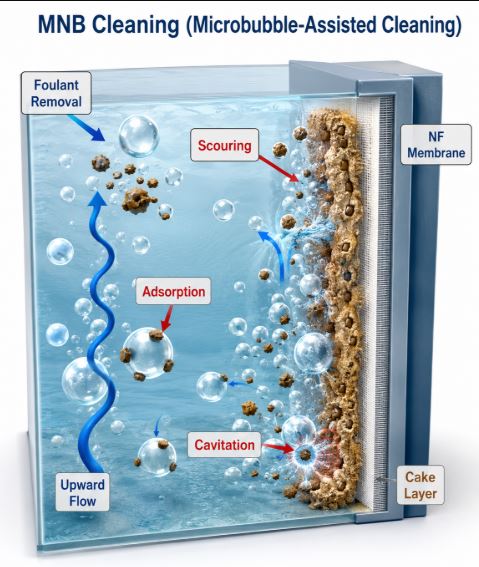
effect of MNBs was attributed to the shear force and collapse phenomenon,
which reduced the formation of a cake layer comprising organic matter (e.g.,
protein-like substances) and bacterial cells on the NF membrane surface.
These results demonstrate the effectiveness of MNB cleaning in mitigating
fouling during submerged NF treatment.
.png)
.png)