https://www.sciencedirect.com/science/article/abs/pii/S1385894725063880
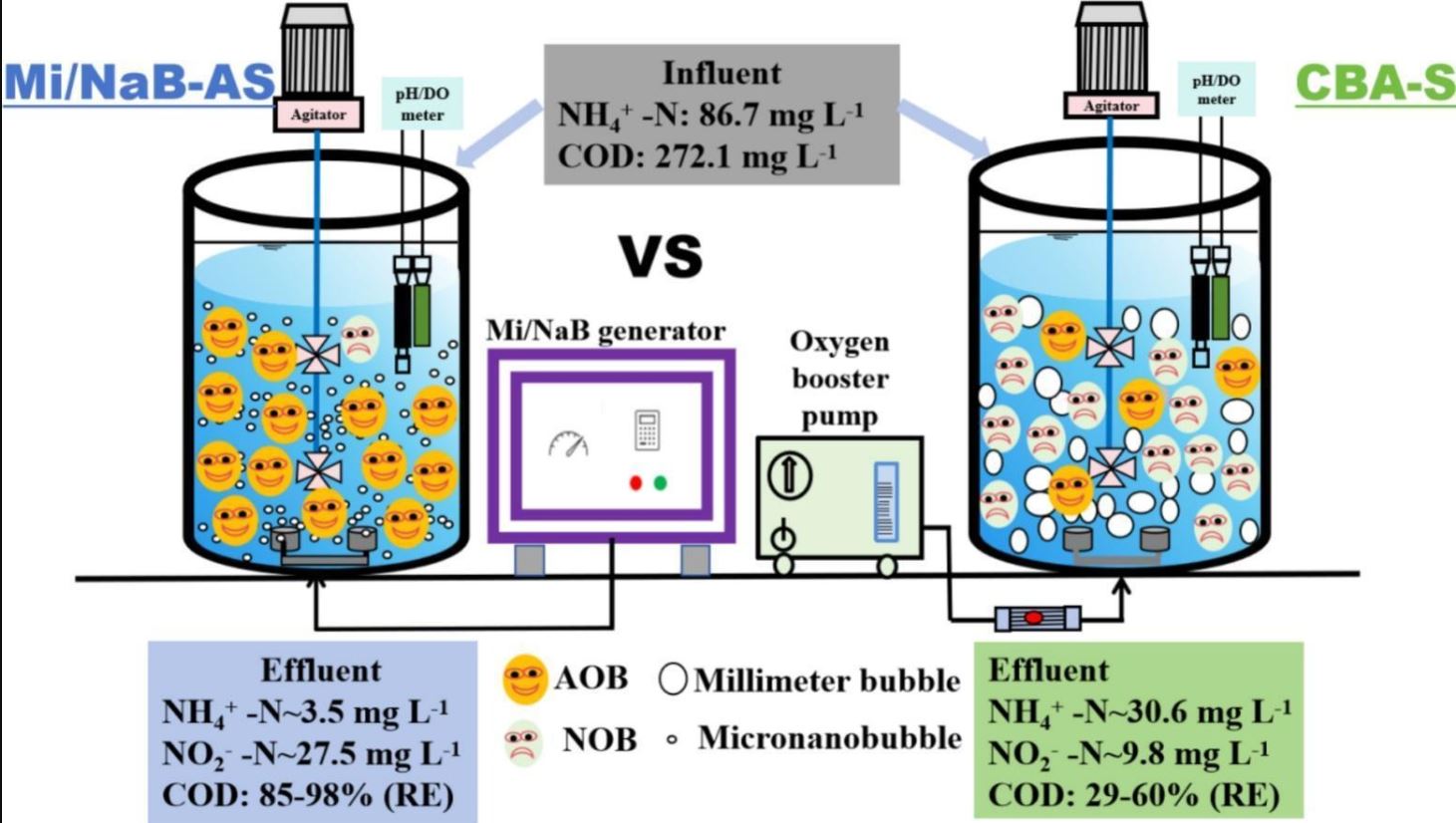
Rapid partial nitrification (PN) system started up in two days under M/NB aeration
M/NB- aeration is recommended to upgrade conventional bubble (CB) aeration
Stable PN system was kept for 210 d purifying real sewage with a mean NAR of >95%.
The new approach increased the relative abundance of AOB genera while the major
NOB Nitrospira was entirely avoided.
M/NB technology saved >70% power than versus traditional aeration.
Partial nitrification (PN) offers significant economic and environmental advantages
; however, achieving a rapid start-up and stable long-term performance remains a
major technical challenge globally. In this study, we demonstrate for the first time
that micro- and nano-bubble (M/NB) technology can serve as a simple yet effective
strategy for the rapid startup and sustained stability of PN in real rural sewage,
while simultaneously achieving >70% energy saving via the application of M/NB
aeration in sequencing batch reactors (SBRs). The oxygen transfer coefficient
(KLa) of M/NB aeration was circa 8.4 times higher than that of conventional
bubble (CB) aeration. Unlike conventional macrobubble systems, the
M/NB-aerated reactor achieved a nitrite accumulation ratio (NAR) of 90.3%
within just two days. Once established, the M/NB-PN reactor maintained a
high NAR (90–97%) despite substantial seasonal fluctuations in ammonia
loading and temperature, demonstrating excellent operational robustness.
The enhanced performance was attributed to the preferential stimulation of
ammonia-oxidizing bacteria (AOB) over nitrite-oxidizing bacteria (NOB)
under M/NB aeration. This shift promoted the enrichment of Nitrosomonas
(AOB) while effectively suppressing Nitrospira (NOB). Furthermore, the
relative abundances of the functional genes amoA and hao in the M/NB-aerated
reactor were more than eightfold and fourfold higher, respectively, compared to
those observed under conventional aeration conditions. Batch experiments
confirmed the reproducibility of this strategy, successfully achieving PN using
non-PN-acclimated seed sludge. Overall, this study introduces a practical and
energy-efficient method for the rapid start-up and stable maintenance of PN,
providing a promising foundation for the implementation of partial nitrification/anammox
(PN/A) and advanced nitrogen removal technologies.