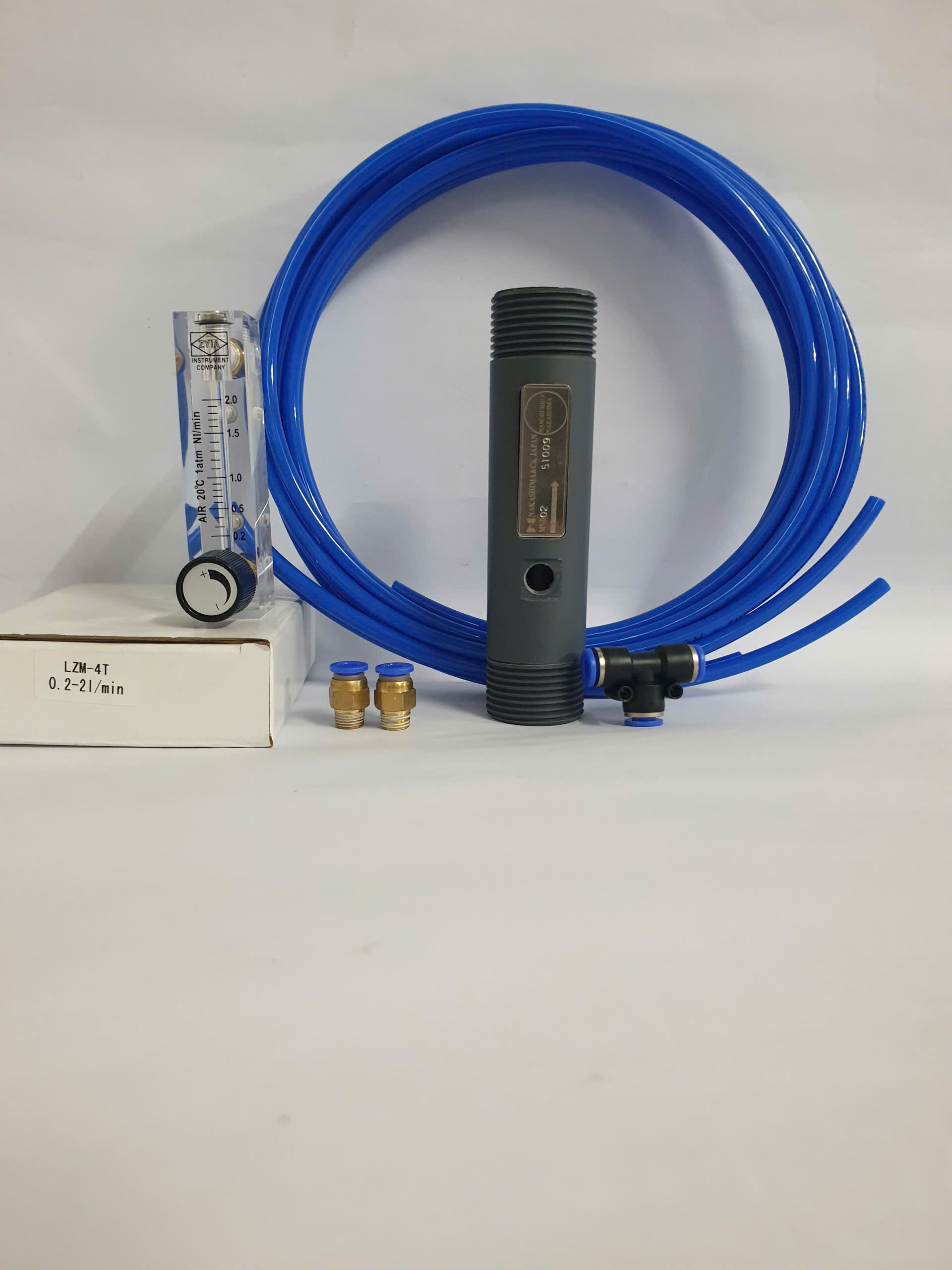
Small-capacity fine-bubble nozzles are particularly valuable for R&D and pilot experiments because they allow researchers to test fine-bubble effects with relatively small water volumes, low energy consumption, and good control of operating conditions
1. Small experimental scale: Can operate with tanks from tens to a few hundred liters, avoiding the need for a large pilot system.
2. Low water requirement: Makes repeated experiments inexpensive and easier to reproduce.
3. Low flow rate: Easier to precisely control water flow, gas flow and pressure—critical for comparing different operating conditions.
4. Easy parameter optimization: Researchers can test different gas/liquid ratios, pressure, nozzle configurations, bubble sizes and residence times.
5. Low energy consumption: Small pumps/blowers can be used, reducing the cost of long-duration experiments.
6. Easy replication: Multiple identical nozzles can be installed on several laboratory tanks for control vs. treatment experiments.
7. Suitable for different gases: Can test with air, pure O₂, O₃, CO₂ and potentially other gases depending on material compatibility and safety requirements.
8. Easy integration: Can be connected to a small pump, oxygen generator, ozone generator, recirculation loop, skimmer or biofilter.
9. Rapid experimentation: Researchers can change operating conditions quickly without modifying a large-scale installation.
10. Scale-up data: Results from small-scale experiments can provide important design parameters before moving to pilot/commercial systems.
I. Aquaculture research
A small nozzle is excellent for laboratory testing of:
Oxygenation
* DO increase
* oxygen transfer efficiency
* oxygen transfer rate (OTR)
* oxygen utilization efficiency
* pure-O₂ vs. air
* fine bubbles vs. conventional aeration
For example, a 100–500 L experimental tank could have:
*Tank → pump → fine-bubble nozzle → tank
Researchers can measure:
* DO vs. time
* kLa
* OTR
* energy consumption
* fish/shrimp respiration demand
* bubble persistence
* water circulation
This is particularly useful when comparing fine-bubble nozzle A vs. nozzle B vs. conventional diffuser.
II. Agriculture research
Fine-bubble nozzles can be used to investigate:
Irrigation water
Test whether oxygen-enriched water affects:
* root-zone oxygen
* root development
* nutrient uptake
* plant growth
* water-use efficiency
Hydroponics
Experiments can compare:
*normal water → oxygenated water → oxygen nanobubble/fine-bubble water
while monitoring:
* DO
* ORP
* root health
* nutrient concentration
* plant biomass
Soil remediation
Fine bubbles can also be investigated for improving gas transfer and oxidation processes in water/soil systems.
III. Wastewater-treatment research
This is one of the strongest applications for a small-capacity nozzle.
Researchers can test:
Aerobic treatment
Evaluate the effect of improved oxygen transfer on:
* BOD removal
* COD removal
* ammonia oxidation
* nitrification
* biological activity
Ozone fine bubbles
A small nozzle can be coupled with an ozone generator to study:
*O₃ → fine bubbles → wastewater
and measure:
* COD reduction
* color removal
* UV254
* turbidity
* oxidation of specific contaminants
* ozone consumption
* ORP
Oxidation enhancement
The same experimental platform can investigate combinations such as:
*O₂ + fine bubbles
*O₃ + fine bubbles
*O₃ + H₂O₂ + fine bubbles
*O₃ + UV + fine bubbles
This makes the nozzle a very useful screening tool for advanced oxidation processes (AOPs)