https://www.sciencedirect.com/science/article/pii/S2214714425018197
Techno-economic analyses are needed to guide NB scale-up
Lack of standardised NB detection post-treatment impedes full-scale validation
Understanding of NB behaviour under real-world conditions remains limited
Full-scale trials show promise in NB-assisted flotation, aeration & water restoration
Nanobubble (NB) technology has been explored in water treatment, yet comprehensive
evaluations of its full-scale implementation remain limited. This review aims to examine
the NB technology's potential to enhance performance and its full-scale deployment
status and future applications in water treatment. The review begins with a summary
of the NB fundamental science to support deeper understanding the NB technology.
It then discusses key NB technology research gaps pertinent to full-scale implementation,
including: treatment mechanisms under realistic conditions, reliable methods for
post-application NB characterisation, performance advantages at full-scale, and long-term
impact/fate of NBs in environmental systems. Comprehensive analysis of pilot- and full-scale
trials in this review highlights that environmental water restoration, supplemental wastewater
aeration, and NB-assisted dissolved air flotation are the most advanced NB applications in
water treatment. Importantly, while NB technology shows promise in improving treatment
efficiency at the research level, its scale-up and potential full-scale adoption remain in early
stages; therefore, its process economics are still unclear. Addressing these challenges requires
long-term pilot/full-scale techno-economic assessment studies to establish NB technology
as a viable solution for water treatment.
.png)
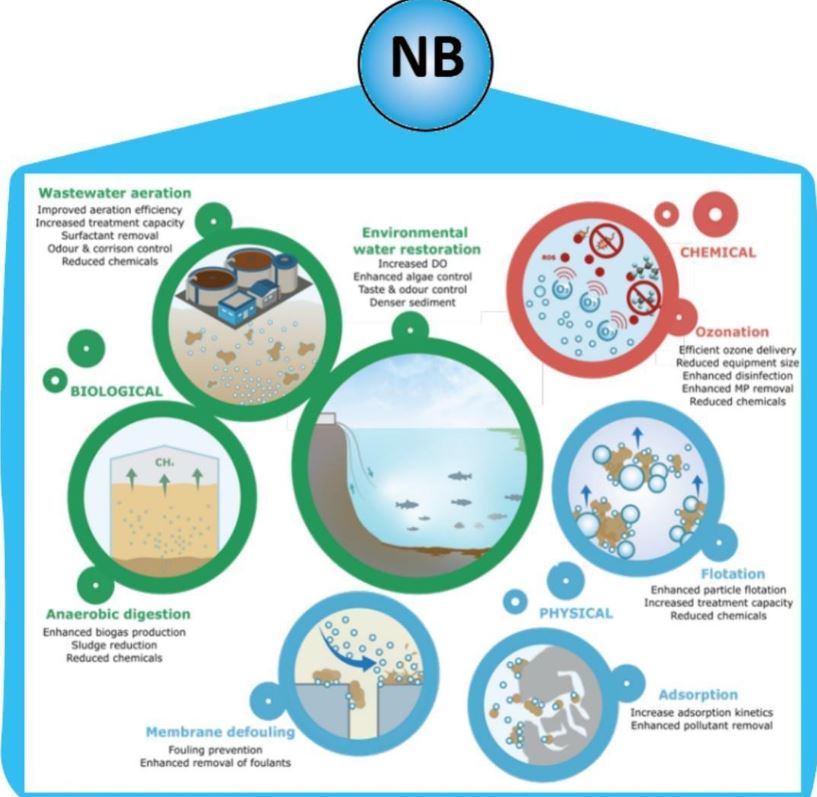
Research on nanobubble (NB) technology has surged in recent years, highlighting its unique
characteristics and potential for water treatment. Three major areas have advanced to full-scale
trials including: environmental water restoration (e.g., surface water aeration/oxygenation and
algae control), supplemental aeration for wastewater intensification, and NB-assisted dissolved
air floatation. Other emerging applications, such as NB integration with advanced oxidation
processes (e.g., ozonation), anaerobic digestion, and membrane cleaning, remain largely at the
lab-scale. Despite this progress, a significant knowledge gap persists between fundamental
research and full-scale application, primarily due to an incomplete understanding of the
mechanisms underpinning NB effectiveness. Lab studies often fail to replicate real water
conditions, while full-scale trials tend to emphasise performance outcomes without providing
mechanistic insights. To bridge this gap, future research should prioritise elucidating treatment
mechanisms under realistic conditions, developing reliable methods for post-application
NB characterisation, and validating performance advantages at full scale. Importantly, there
is an urgent need to carry out rigorously designed experiments to obtain conclusive evidence
of the performance advantages of NB technology compared with standard methodologies
to disperse gases in water and wastewater. In parallel, techno-economic assessments and
long-term operational studies are needed to support industry adoption but should
complement, not replace, fundamental research efforts. Addressing these research gaps
will be critical to unlocking the full potential of NB technology, enabling more efficient,
resilient, and sustainable water treatment solutions.