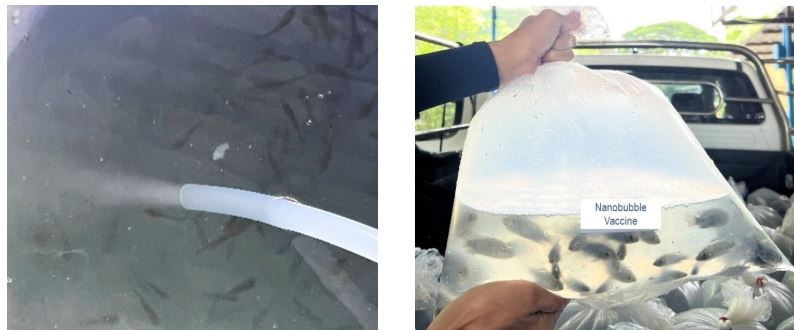
Enter nanobubbles – minuscule gas bubbles (<200 nm) that, when introduced into water, can improve water quality, boost fish immunity, and enhance the uptake of immersion vaccine into fish gills. Dr. Dong’s project, funded by a CA$872,000 grant from the International Development Research Center (IDRC) in Canada, aims to harness this innovative technology to reduce antibiotic reliance in aquaculture and revolutionize fish health management.
.png)
....
The project’s objective is to enhance immersion vaccine efficacy using nanobubble technology, adapt it for commercial use in tilapia farms, and transfer this knowledge to the private sector.
The “nanobubble-vaccine” approach is particularly promising, and could potentially revolutionize tropical aquaculture health management practices for small-scale farmers, Dr. Dong explained.
“The project aims to adapt this technology for commercial use in tilapia farms – a game-changer for small-scale farmers who often lack access to advanced health management practices,” Dr. Dong said
.png)
Over 32 months, the project will not only improve fish health but also empower farmers via knowledge transfer sessions on nanobubble technology applications, and training workshops, Dr. Dong stressed.
AIT’s collaboration with partners such as CENTEX Shrimp (Mahidol University/BIOTEC-NSTDA), Kasetsart University, and Chulalongkorn University enhances the project’s capacity for success. An expert advisory panel consulting this project includes Dr. Saengchan Senapin from BIOTEC/NSTDA, Dr. Krishna R. Salin from AIT, Dr. Channarong Rodkhum from Chulalongkorn University, and Dr. Satid Chatchaiphan from Kasetsart University. Their collective expertise ensures that the project’s execution is scientifically robust and geared towards tangible outcomes.
Industrial partners like Nam Sai Farms Co. Ltd., along with small-scale farmers, will prove vital to implementing this innovative technology at the grassroots level. The project is also investing in future scientific talent by offering two PhD scholarships, one postdoctoral position, and two research assistant opportunities.
According to Dr. Dong, the project holds promise for substantially enhancing aquaculture sustainability across Asia and the Pacific.
“By reducing bacterial disease outbreaks and antibiotic use through nanobubble-vaccine technology, the study represents a significant stride towards a healthier aquatic ecosystem, a safer food supply chain, and a thriving sustainable aquaculture industry in Asia,” he said.