https://www.mdpi.com/2313-4321/11/2/24#
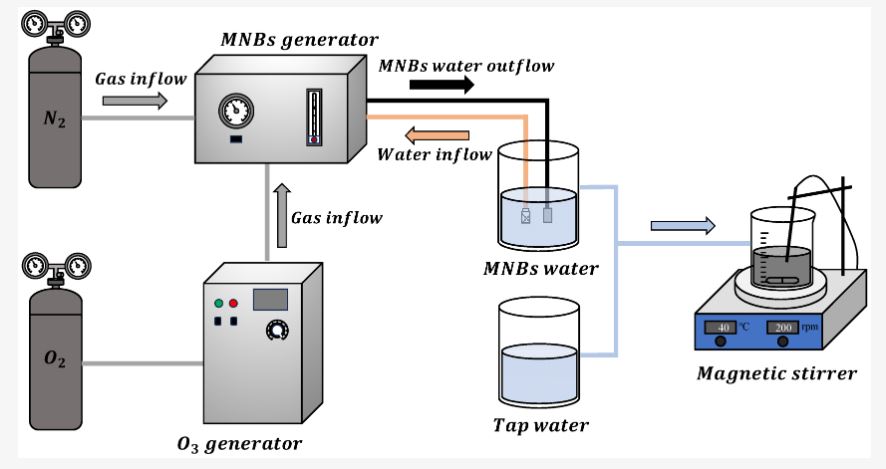
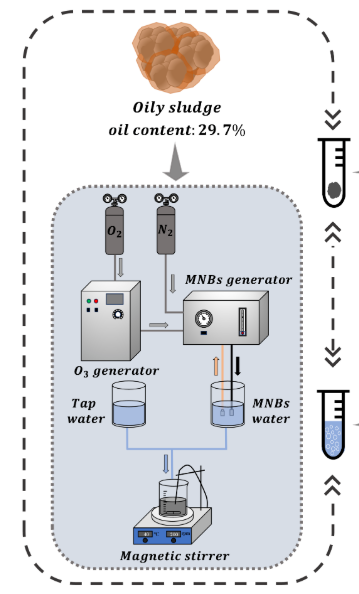
Oily sludge is a complex emulsified waste consisting of water, oil, and solid particles. Conventional treatments are often inefficient, energy-intensive, and prone to causing secondary pollution. This study proposes a green demulsification technology based on ozone micro–nanobubbles (O3MNBs) by constructing an experimental system to analyze its effects and mechanisms of action on oily sludge treatment. The O3MNBs exhibited a mean particle size of 831 nm and generated a substantial amount of hydroxyl radicals (·OH, 250.4 μmol·L−1) in situ. Compared with conventional aeration, the dissolved ozone concentration and residence time in water of O3MNBs increased by 192% and 213%, respectively. During bubble collapse, intense pressure waves and high-speed microjets were generated to disrupt sludge aggregates, promoting the dispersion of sludge particles while simultaneously stripping oil films. Thus, the oil removal rate reached 41.5%, demonstrating the high demulsification efficiency of O3MNBs. Furthermore, ozone and ·OH attacked alkane C-H bonds in the oil phase, oxidizing hydrophobic films into hydrophilic products and decomposing surfactants that stabilize emulsions. This process promoted oil droplet coalescence and degradation into small organic molecules. After O3MNB treatment, the absorption peak of alkane C-H bonds gradually reduced, while a new C=O absorption peak appeared. This study provides a theoretical foundation and technical support for environmentally sustainable treatment of oily sludge by O3MNB application, offering an effective alternative to chemical demulsification without secondary pollution.
Based on the characteristics of MNBs generated by different gas sources and their demulsification effects on oily sludge, this study explored and examined the demulsification performance and mechanisms of MNBs. The main conclusions are as follows:
(1) O3MNBs have excellent physicochemical properties, with a bubble diameter of 831 nm and a concentration of ·OH in water of 250.4 μmol·L−1. Compared with conventional aeration (5.6 mg·L−1), the ozone concentration in O3MNB water (16.4 mg·L−1) increased by 192%.
(2) MNBs generated from different gas sources can effectively demulsify oily sludge. O3MNBs had the highest oil removal rate of 41.5%. The absorption peak of C-H bonds in alkanes in oily sludge after O3MNB treatment was significantly weakened, the weight loss rate of light and heavy components was the lowest, the content of carbon element decreased, and the content of oxygen element increased.
(3) O3MNBs can effectively demulsify oily sludge through physical–chemical synergistic effects. The mechanism involves shockwaves and microjets generated by bubble collapse, as well as the strong oxidation by ozone and ·OH, which promote the detachment of the oil phase from the surface of the solid phase, induce chain scission and hydrophilization of petroleum hydrocarbons, and enhance the oxidation and degradation of petroleum hydrocarbons. These processes can promote the efficient separation of the oil–water–solid three-phase system, improve the recovery and utilization efficiency of both the oil and solid phases, and support resource recovery and the development of a circular economy.
.png)