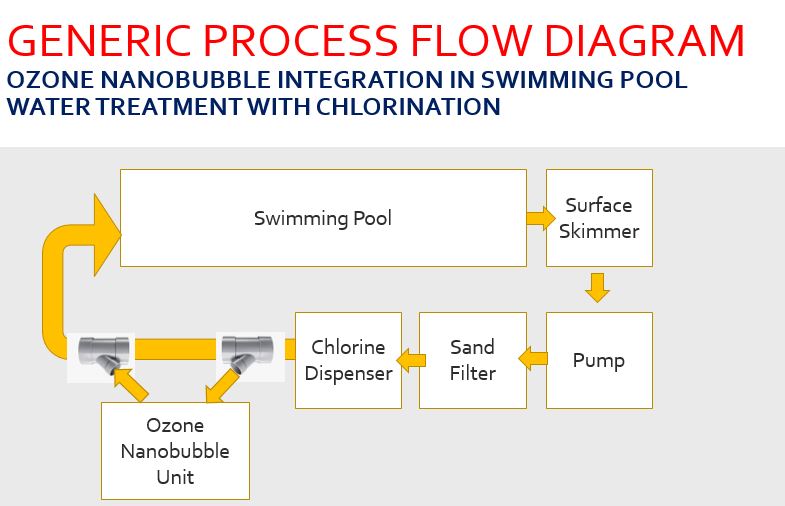
For Commercial and Home-use swimming Pools, Ozone Nanobubbles can help reduce chlorine consumption by 70% to 90% by shifting chlorine's role from primary sanitizer and organic oxidizer to a minimal, long-lasting residual safeguard. Excessive chlorine causes itchy skin by stripping away human body's natural oils and disrupting the protective skin barrier.
Ozone Nanobubbles help eliminate organic load and breaking down chloramines in the return line, free chlorine residual lasts up to four times longer in the basin, lowering daily chemical costs, stabilizing pH, and producing crystal-clear, odorless pool water
Ozone Nanobubble Principle in Reducing Chlorine Demand
Advanced Oxidation via Hydroxyl Radicals (-OH):
As ozone nanobubbles collapse under pressure or contact surfaces, they trigger an Advanced Oxidation Process (AOP) generating hydroxyl radicals (-OH).
These radicals possess a very high oxidation potential of 2.80 V (compared to 1.36 V for chlorine), destroying organics, bodily fluids, and cosmetics before they can consume free chlorine.
Direct Destruction of Chloramines (Combined Chlorine):
Chlorine becomes tied up and ineffective when reacting with nitrogenous waste, forming irritants called chloramines (which cause eye sting and chemical smell). Hydroxyl radicals rapidly break the strong nitrogen-chlorine bonds, converting chloramines back into harmless nitrogen gas (N2) and free chloride ions, effectively freeing up chlorine to continue sanitizing.
Pathogen Inactivation Without Residual Depletion:
Ozone nanobubbles destroy hard-to-kill, chlorine-resistant pathogens like Cryptosporidium parvum and Giardia within seconds through cell-wall lysis.
Because ozone handles the bulk microbial load in the filtration loop, free chlorine residual in the basin is not rapidly depleted.
Suspended Particle Agglomeration & Filtration:
Nanobubbles carry a strong negative surface charge (Zeta potential= -20mV to -50mV). They attach to fine suspended solids and colloidal organic matter, causing micro-flocculation. This allows media filters (sand, glass, or cartridge) to capture fine particles that would otherwise consume dissolved chlorine through slow oxidation.
Long-Term Water Stabilization:
Unlike macro-bubbles that immediately off-gas, nanobubbles exhibit neutral buoyancy and remain suspended in the bulk water for weeks. This continuous gas phase acts as an active chemical reservoir, continuously suppressing bacterial regrowth in quiet zones, dead spots, and pipe walls.