https://www.sciencedirect.com/science/article/abs/pii/S2214714426000681?via%3Dihub
Effective removal of typical compounds like perfluorooctanoic acid (PFOA)
and perfluorooctanesulfonic acid (PFOS) is crucial for drinking water safety.
Foam fractionation shows promise for PFAS removal, but its efficacy is limited by
the low PFAS concentrations in natural waters, which hinder interfacial adsorption
and foam stability. This study synthesized a novel green surfactant, octanoyl
chloride-modified chitosan (OTCS), and developed an enhanced foam fractionation
system coupled with micro-nano bubbles technology (OTCS-MNBs) for the efficient
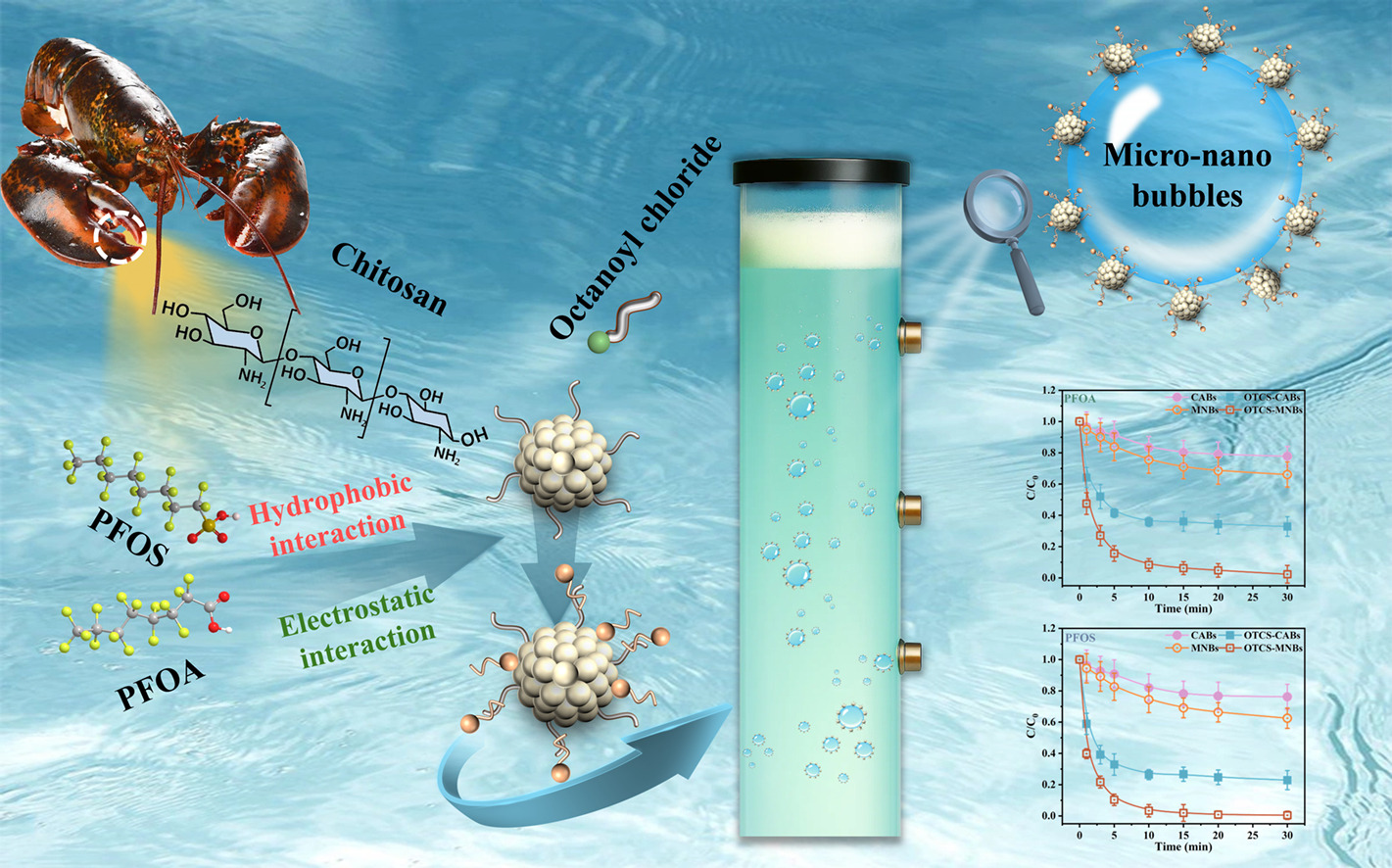
removal of PFOA and PFOS. Compared to the OTCS-conventional air bubbles foam
fractionation system OTCS (OTCS-CABs), the OTCS-MNBs system achieved removal
efficiencies of 98.73% and 99.21% for PFOA and PFOS, respectively, representing improvements
of 1.47-fold for PFOA and 1.29-fold for PFOS. The system demonstrated pH adaptability
(pH 3–9) and excellent foam stability, with moderate ionic strength enhancing reaction
kinetics through salting-out effects. Analysis revealed that micro-nanobubbles exhibited
higher specific surface area, longer residence time, and superior resistance to coalescence
compared to conventional bubbles, thereby providing more adsorption sites and sufficient
contact time for PFAS. In practical water experiments conducted with four typical Chinese
lakes and reservoir sources, the system achieved removal efficiencies exceeding 80% for
PFOA/PFOS, demonstrating its potential for practical application in complex water conditions.
This highly efficient and environmentally friendly foam fractionation process effectively
mitigates the environmental and health risks associated with PFAS and provides valuable
technical guidance for water treatment plants addressing emerging contaminant challenges
In this study, a micro-nano bubbles foam fractionation system coupled with octanoyl
chloride–modified chitosan (OTCS–MNBs) was developed for the efficient removal of PFOA
and PFOS from water. By introducing hydrophobic alkyl chains onto the chitosan backbone,
OTCS provided dual hydrophobic–electrostatic binding sites, which, in synergy with the high
surface area and stability of MNBs, significantly enhanced foam formation and pollutant
enrichment at the gas–liquid interface.