https://www.sciencedirect.com/science/article/pii/S2352513426001183
treatment raised hatching rate to 90.12 %.
Nanobubble technology has recently been applied in various aquaculture systems.
However, its application in seed production remains understudied. This study evaluates
the effects of ozone nanobubbles (O₃NB) during the embryonic stage and oxygen
nanobubbles (O₂NB) during the fry stage in rainbow trout (Oncorhynchus mykiss).
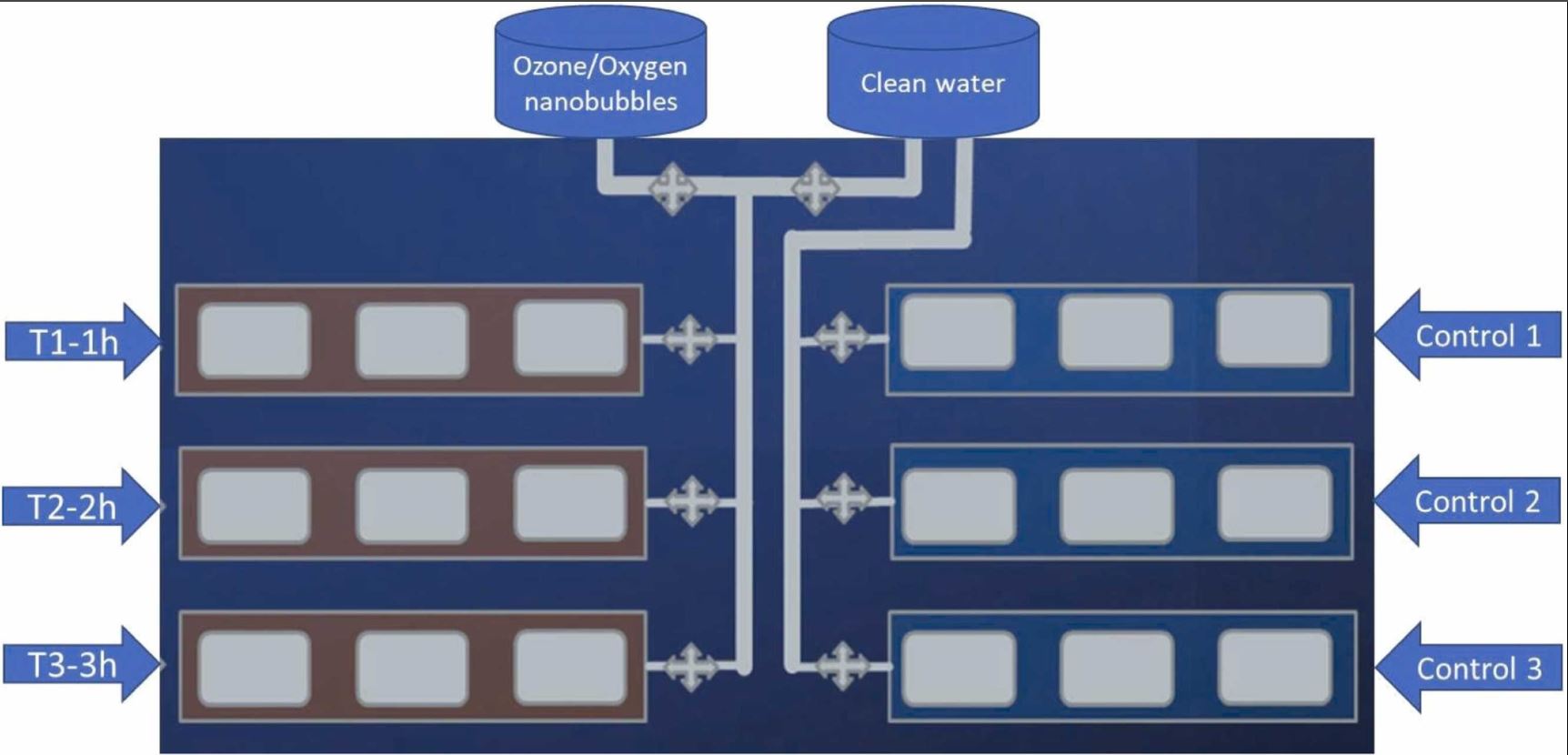
Fertilized eggs at stage pigmented eyes were treated daily with O3NB at concentrations
of 0.22 ± 0.02 – 0.23 ± 0.02 mg/L for 1 h (T1), 2 h (T2), and 3 h (T3), along with a
non-treated control group. Each group was replicated three times. Hydrochemical
parameters, including temperature, pH, Dissolved Oxygen (DO), Oxidation-Reduction
Potential (ORP), ozone (O3), N-NH4, H2S, N-NO2, Chemical Oxygen Demand (COD),
and P-PO43-, as well as pathogenic agents (fungi), embryo morphology, and histopathology
were monitored daily. The results showed that water quality in groups T1, T2, and T3
differed significantly from the control group, with higher ORP values and lower levels
of COD, N-NH₄, and total heterotrophic bacterial count (p < 0.05). The infection rate
of Saprolegnia spp. in T1, T2, and T3 (0.89 ± 0.8 %, 0.33 ± 0.7 %, and 0.78 ± 0.4 %, respectively)
was significantly lower compared to the control group (5.44 ± 1.9 %) (p < 0.05).
The larval deformity rate in T1 (0.87 ± 0.11 %) was lower than in T3 (1.63 ± 0.25 %) (p < 0.05).
Our study recommends that treatment with ozone nanobubbles (0.23 - 0.23 mg/L for 1 h)
during embryogenesis, combined with maintaining dissolved oxygen at 10 mg/L using oxygen
nanobubbles post-hatching, effectively reduces pathogen infections and enhances survival in rainbow trout.
.png)
Ozone nanobubbles demonstrated efficacy in controlling fungal pathogens on eggs during
the hatching stage. Ozone nanobubbles at concentrations of 0.21–0.25 mg/L for 1–2 h of
treatment did not negatively impact embryo development or increase deformity rates.
However, ozone nanobubbles were associated with fish mortality and significant gill damage in the fry stage.
A treatment protocol involving ozone nanobubbles during the embryonic stage for 1 h,
coupled with maintaining dissolved oxygen level at 10 mg/L after hatching, obtained a
high survival rate of 90.12 %. To advance practical applications, further testing of ozone
and oxygen nanobubbles on fish eggs at the farm scale is essential. Additionally,
comprehensive studies are needed to investigate the effects of ozone nanobubbles on the
biochemical processes of the embryo.