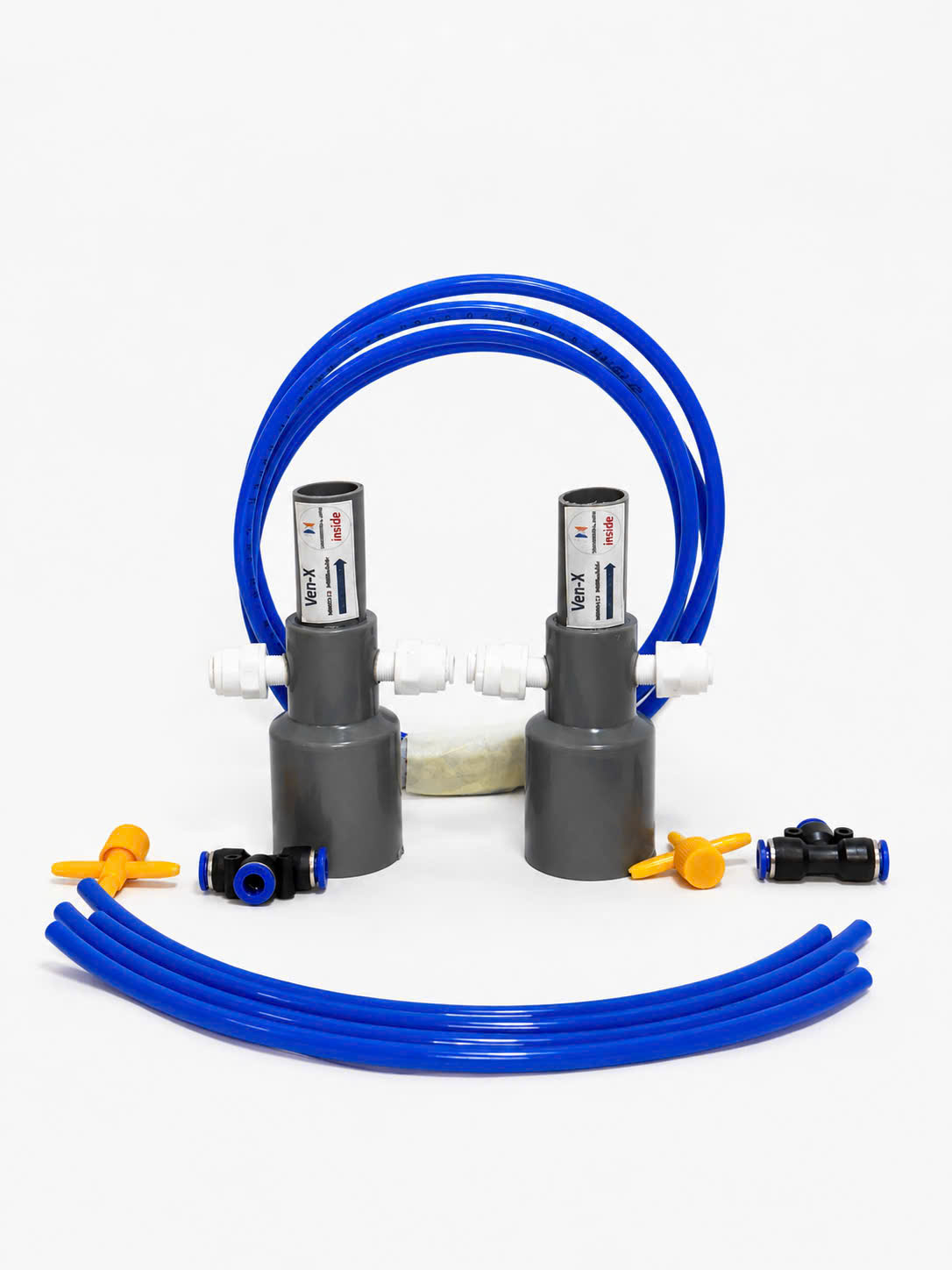
Finer bubbles are important in a protein skimmer because foam fractionation depends strongly on the gas–water interfacial area and the ability of dissolved/colloidal organic matter to attach to bubble surfaces.
For the same volume of injected air or oxygen, reducing bubble diameter dramatically increases total gas–water surface area.
For spherical bubbles:
.png)
where d = bubble diameter
For example, approximately:
| Bubble diameter | Relative surface area |
|---|---|
| 2 mm | 1× |
| 1 mm | 2× |
| 500 µm | 4× |
| 100 µm | 20× |
| 50 µm | 40× |
So a skimmer producing 100 µm bubbles can theoretically provide ~20× the interfacial area of 2 mm bubbles for the same gas volume.
Protein skimming does not primarily "filter" particles mechanically. Hydrophobic and surface-active substances—proteins, peptides, fats, bacterial metabolites, dissolved organic compounds, etc.—preferentially accumulate at the air–water interface.
More bubble surface means more available sites for these compounds to adsorb.
Therefore: Finer bubbles → more interface → greater organic loading → potentially more foam production.
This is particularly important.
Large bubbles tend to:
- rise rapidly
- have relatively little surface area
- coalesce easily
- produce a coarse, unstable foam
Fine bubbles:
- rise more slowly
- remain suspended longer
- collide and interact with dissolved organics
- form a denser bubble population
- create a more persistent foam layer
This gives the skimmer more opportunity to concentrate the organic material before the foam reaches the collection cup.
Bubble velocity generally decreases as bubble size decreases, particularly in the small-bubble regime.
So in a counter-current skimmer, fine bubbles can remain in the reaction/foam column longer.
This is one reason the combination is powerful: fine bubbles + counter-current flow
Water containing organics travels downward while bubbles travel upward:
The counter-current arrangement continuously exposes relatively clean bubbles to water containing organic matter.
There is an important engineering optimum.
Extremely small nanobubbles can have excellent surface area, but a protein skimmer needs bubbles that can also form and transport a stable foam column.
If bubbles are too small, you can encounter:
- excessive foam stability
- very slow bubble rise
- difficulty separating water from foam
- excessive water carryover
- unstable skimmer tuning
Therefore, for conventional protein skimmers, microbubbles are generally more useful than relying exclusively on nanobubbles.
A practical conceptual range is often around 50–500 µm, with the optimum depending on salinity, organic loading, skimmer geometry, air flow, water flow, and foam-column height.
For intensive shrimp and fish systems, finer bubbles can improve the skimmer's ability to remove:
Feed residues → proteins/peptides → bacterial EPS → colloidal organics → fine suspended organic matter
This can reduce the organic load returning to the culture system and consequently help:
- lower BOD/COD pressure
- reduce bacterial growth substrate
- improve water clarity
- reduce foam/organic accumulation
- improve biofilter operating conditions
- reduce oxygen consumption by heterotrophic decomposition