Enhanced heavy metal stability of sludge anaerobic digestion by different dosages of air nanobubble water
https://www.sciencedirect.com/science/article/abs/pii/S2214714425016332
SRF and CST were negatively correlated with low valence/energy levels of HMI.
The ecological risk index of HMs was negatively correlated with methane production.
The ecological risk index of HMs was positively correlated with SRF and CST.
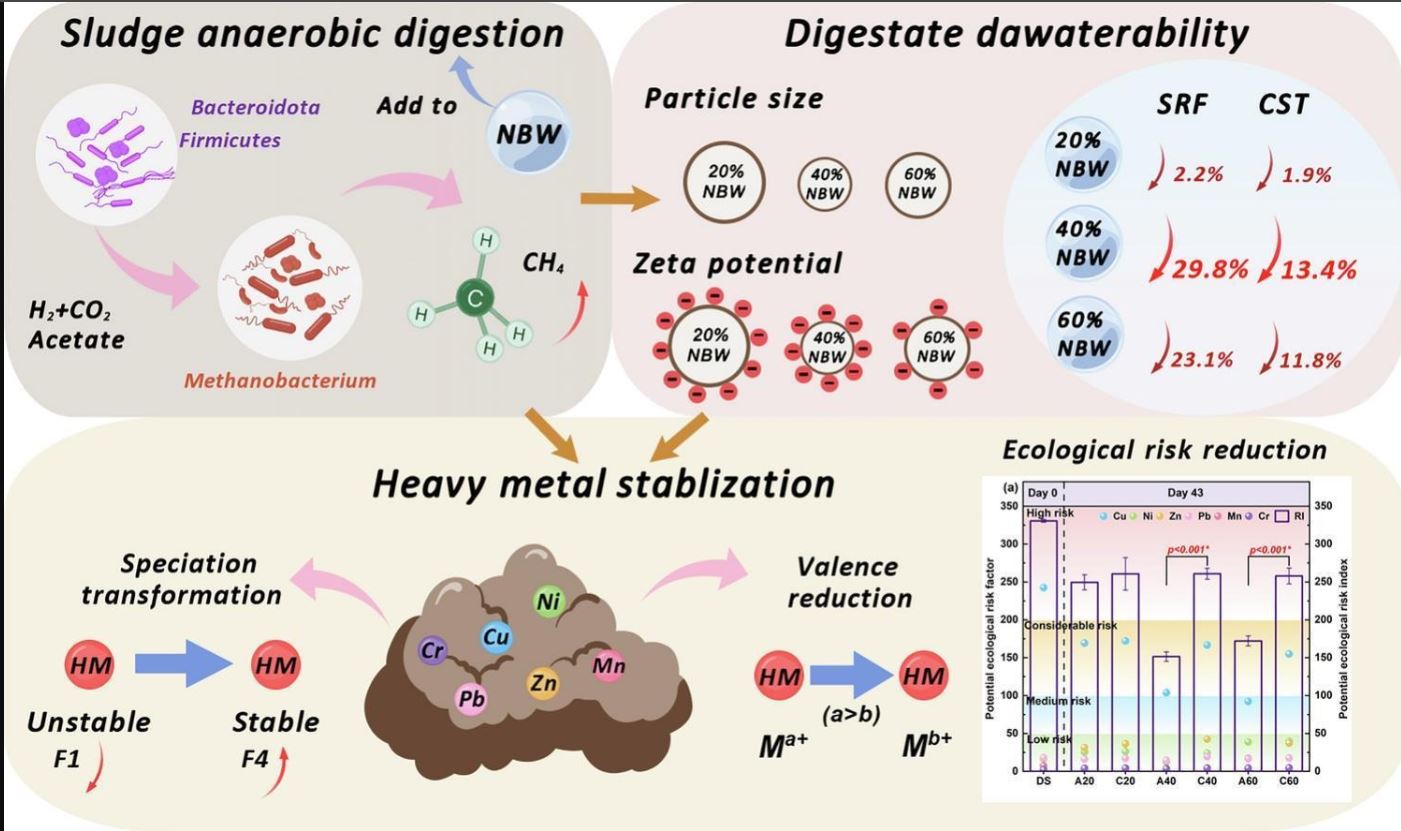
NBW decreased the ecological risk index of final digestate by 4.2 %–42.0 %.
Nanobubbled water (NBW) can improve the performance of sludge anaerobic digestion
(AD) to enhance digestate dewaterability. However, the effects of different doses of NBW
on the stability of heavy metals (HMs) remain unknown. This study found that NBW
increased the ultimate methane production of sludge AD by 11.7 %–16.0 %. Compared
with the corresponding control groups, the 40 % Air-NBW group (A40) presented the
best improvement in methane production and digestate dewaterability of the three
different dose groups (20 %, 40 %, and 60 % NBW: mixed substrates). NBW contributed
to decreasing the proportion of HMs in the unstable exchangeable/acid-soluble fraction
and promoting the conversion of heavy metal ions to stable low-valence states and low-energy levels.
These low-valence states and low-energy levels of HMs were positively correlated with digestate
dewaterability and methane production. NBW reduced the potential ecological risk index (RI)
of HMs by 4.2 %–42.0 %, with the A40 showing the greatest reduction in ecological risks.
The RI of HMs was negatively correlated with methane production and digestate dewaterability.
NBW can simultaneously improve methane production, digestate dewaterability, and
heavy metal stability in sludge AD, with 40 % NBW being the optimal dose.
This study provides a new sludge treatment strategy for controlling HMs pollution.
Among the three different dose groups, the 40 % NBW group (A40) exhibited
the best methanogenesis and dewaterability of the final digestate, with a
16.0 % increase in methane production and a 29.8 % and 13.4 % decrease in
SRF and CST, respectively, compared with the control. Additionally, NBW favored
decreasing the proportion of HMs with the unstable exchangeable/acid-soluble fraction
and promoted the conversion of HMI to stable low-valence states and low-energy levels in the digestate