https://www.mdpi.com/2073-4441/17/4/566
Antibiotics in aquaculture pose significant environmental risks due to their
widespread distribution in water, impacting ecosystem health. To address
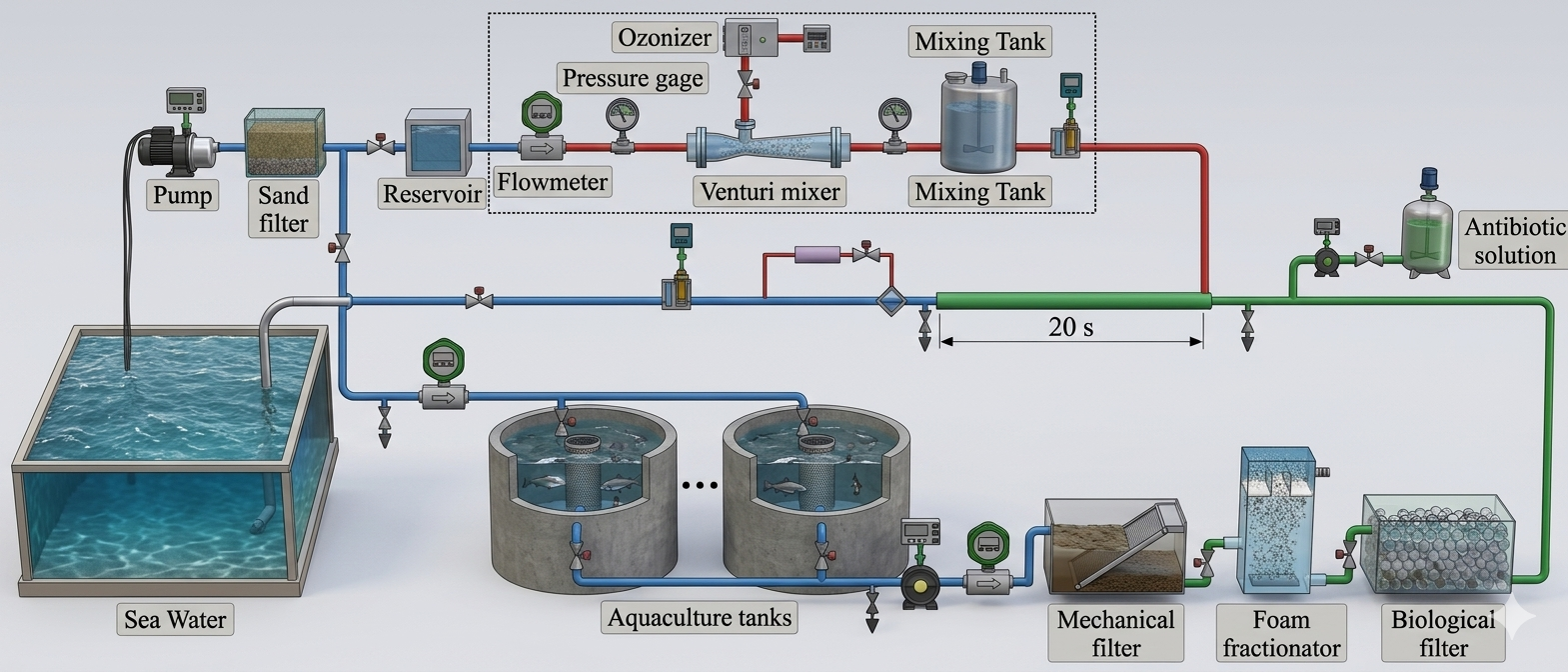
this hot issue, an ozone-assisted hydrodynamic cavitation (OAHC) system
was developed for the efficient treatment of aquaculture seawater contaminated
with antibiotics. The system demonstrated remarkable efficiency, achieving
complete degradation of eight antibiotics within a reaction time of 20 s.
At the same time, water quality parameters, such as dissolved oxygen
(increased from 9.79 mg/L to 13.19 mg/L) and nitrite nitrogen (reduced from
0.14 mg/L to 0.01 mg/L), significantly improved post-treatment. The OAHC-based
system minimized harmful by-products, ensuring compliance with Chinese water
quality standards. As a supplementary study, a laboratory-based simulated experiment
was conducted with FLO as the target antibiotic. The investigation of kinetics and
mechanisms indicated that •OH plays a predominant role in the OAHC-based aquaculture
seawater treatment system. As global regulations tighten on antibiotic discharge,
OAHC-based technology is poised to become a cornerstone of next-generation water
treatment solutions. Future research should prioritize field-scale validation and real-time
monitoring to accelerate industrial adoption.
In recent years, O3-AOPs have attracted extensive attention due to the strong oxidation
and relative environmental friendliness of ozone. However, the high costs and substantial
energy requirements associated with these processes restrict their large-scale industrial
applications. An OAHC-based system was developed for the efficient treatment of aquaculture
seawater contaminated with antibiotics, which shows high efficiency. The main conclusions are as follows:
(1)
Based on the combination of strong ionization discharge and hydraulic cavitation,
the OAHC-based system exhibits excellent degradation efficiency for antibiotics within a reaction time of 20 s.
(2)
Following treatment by the OAHC-based system, all water quality parameters met the
limits specified in the Chinese Sea Water Quality Standard, and the DBPs complied with the
China National Standards for drinking water quality.
(3)
The degradation process of FLO can be divided into two stages: the initial direct degradation
by ROS generated during the miscible process under hydraulic cavitation, followed by continuous
oxidation promoted by residual ozone in the water.
(4)
The FLO degradation in the OAHC-based system can be attributed to three primary pathways:
(a) substitution reaction at highly electronegative sites; (b) cleavage of the C-N bond;
and (c) the electrophilic attacking at the site of the benzene ring.