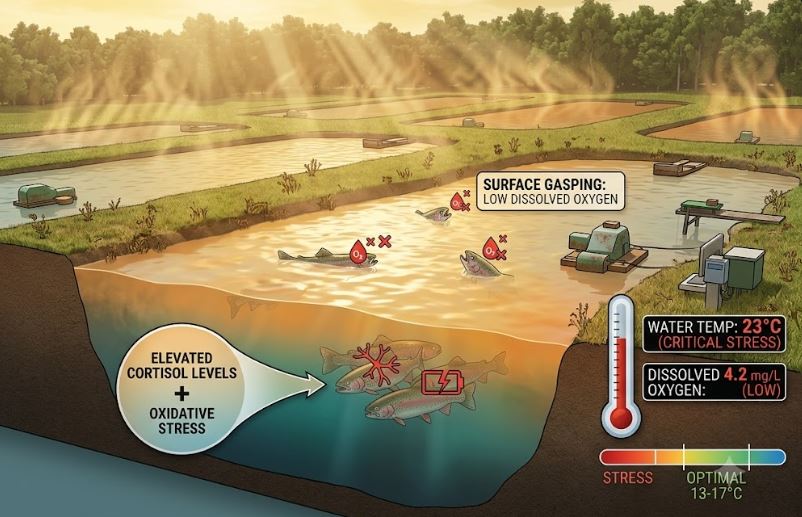
For outdoor soil ponds holding cold-water fish such as sturgeon and rainbow trout, elevated sunshine/heat can create a particularly dangerous combination: warmer water + lower oxygen solubility + stronger biological oxygen demand + deterioration of bottom sludge.
.png)
As water temperature rises, its maximum oxygen-holding capacity falls.
For example, freshwater at approximately:
| Water temperature | DO saturation at sea level |
|---|---|
| 10°C | ~11.3 mg/L |
| 15°C | ~10.1 mg/L |
| 20°C | ~9.1 mg/L |
| 25°C | ~8.3 mg/L |
| 30°C | ~7.5 mg/L |
For rainbow trout and sturgeon, this is important because they are relatively cold-water fish and generally have higher oxygen requirements than many warm-water species.
The problem is therefore not simply:
Heat → fish become stressed
but rather:
Heat → lower O₂ solubility → higher fish respiration/stress → greater oxygen consumption → faster DO depletion
During daytime, algae/phytoplankton may produce substantial oxygen through photosynthesis.
But during the night:
algae + bacteria + sludge + fish → consume oxygen
So a heavily sunlit pond can sometimes have:
Afternoon: high DO
↓
Evening: DO begins falling
↓
Early morning: minimum DO
↓
Fish stress / mortality
This becomes especially dangerous after several very hot/cloudy days, when algae become unstable or suddenly die.
This is often the hidden problem in soil ponds.
Organic sludge consists of:
Under high temperature, microbial decomposition becomes more active.
Therefore:
Heat → faster decomposition → higher oxygen consumption by bacteria → oxygen depletion near the bottom.
When the bottom becomes oxygen-deficient:
Aerobic decomposition ↓
and anaerobic processes become increasingly important.
This can generate undesirable reduced compounds such as:
A useful way to visualize the problem is:
Hot surface water
↓ temperature/oxygen gradient
Low-DO bottom water
↓
Oxygen-depleted sludge
↓
Anaerobic decomposition
↓
H₂S + reduced compounds + more oxygen demand
↓
Fish stress
This is particularly problematic if fish disturb the bottom sediment.
Fine bubbles can attack several parts of this chain simultaneously.
Fine bubbles provide much greater gas-liquid interfacial area than coarse bubbles.
Instead of:
large bubble → rises quickly → limited contact time
you get:
many small bubbles → large surface area → slower rise → longer contact → greater O₂ transfer
This can maintain higher DO particularly during:
For cold-water fish, the objective should generally be stable DO, rather than simply producing a very high DO for a short period.
This is perhaps the most interesting advantage for a soil pond.
When fine-bubble nozzles are positioned strategically near the bottom, oxygenated water can be circulated upward:
Bottom oxygenation
→ aerobic microbial activity
→ more complete organic decomposition
→ less anaerobic sludge accumulation
→ lower risk of H₂S generation.
The goal is not necessarily to physically oxidize all sludge immediately. Instead, the objective is to keep the sediment-water interface from becoming strongly anaerobic.
A properly designed fine-bubble system can create an airlift effect:
oxygenated bottom water ↑
surface water ↓
This reduces stratification.
Instead of having:
warm/high-O₂ surface
↓
thermocline
↓
cold/low-O₂ bottom
you encourage more uniform water quality throughout the pond.
For deep outdoor ponds, this can be very valuable.
Fine bubbles do not simply "control algae".
Their more important role is maintaining oxygen and circulation so that the pond is more resilient when algae populations fluctuate.
A dangerous sequence is:
strong sunshine
→ algae bloom
→ high afternoon DO
→ algae consume O₂ at night
→ algae die/collapse
→ bacteria decompose dead algae
→ enormous oxygen demand
→ early-morning DO crash
Fine-bubble oxygenation can provide a buffer against this oxygen crash.
A practical control strategy could be:
| Condition | Fine-bubble operation |
|---|---|
| Normal cool weather | Moderate |
| Hot sunny afternoon | Increase |
| Very hot day | High |
| Night | High/continuous |
| Pre-dawn | Highest priority |
| Heavy algae bloom | High + monitor DO |
| After heavy rain/cloudy weather | High |
| Algae crash suspected | Immediate high oxygenation |
The pre-dawn period is particularly important because photosynthesis has stopped for many hours while fish, bacteria and sludge have continued consuming oxygen.