Oxygen Cones- Downflow Bubble Contactors
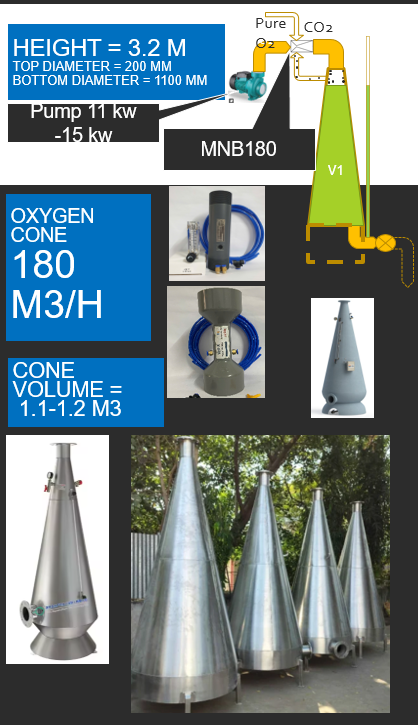
Oxygen cones (downflow bubble contactors) are highly efficient pressure vessels used in intensive aquaculture to supersaturate water with pure oxygen gas.
Combined a Venturi injector, Oxygen Cones deliver excellent performance with much higher gas-liquid mass transfer up to 93-95% gas efficiency in high-density Recirculating Aquaculture Systems (RAS).
Basic Design Principles
An oxygen cone relies on fluid dynamics and pressure to maximize oxygen dissolution:
* Inverse Cone Geometry: The vessel is narrow at the top and widens toward the bottom, creating a vertical water velocity gradient.
* Terminal Velocity Balance: As water flows downward, its velocity decreases. This matches the buoyant rise velocity of the oxygen bubbles, trapping them in suspension until they completely dissolve.
* High-Pressure Operation: Cones typically operate under pressures of 2 to 3 bar (30–45 psi), significantly increasing oxygen solubility limits based on Henry's Law.
Venturi Integration and Operation
The Venturi injector serves as the primary pre-mixing and gas-induction mechanism:
* Motive Flow Generation: A water pump forces a pressurized stream through a converging-diverging Venturi nozzle, creating a localized low-pressure zone (vacuum).
* Microbubble Creation: Pure oxygen (O2) is drawn into the throat of the Venturi, shearing the gas into a dense fog of microbubbles.
* Injection into the Cone: This oxygenated, turbulent mixture enters the top inlet of the cone at high velocity, initiating immediate secondary dissolution under pressure.
Key Operational Advantages
* Exceptional Transfer Efficiency: Reaches 93% to 95% oxygen absorption, virtually eliminating wasted gas.
* High Stocking Density Support: Safely maintains dissolved oxygen (DO) levels well above 100% saturation without dangerous off-gassing.
* Compact Footprint: Delivers massive amounts of oxygen to large water volumes in a relatively small equipment footprint.