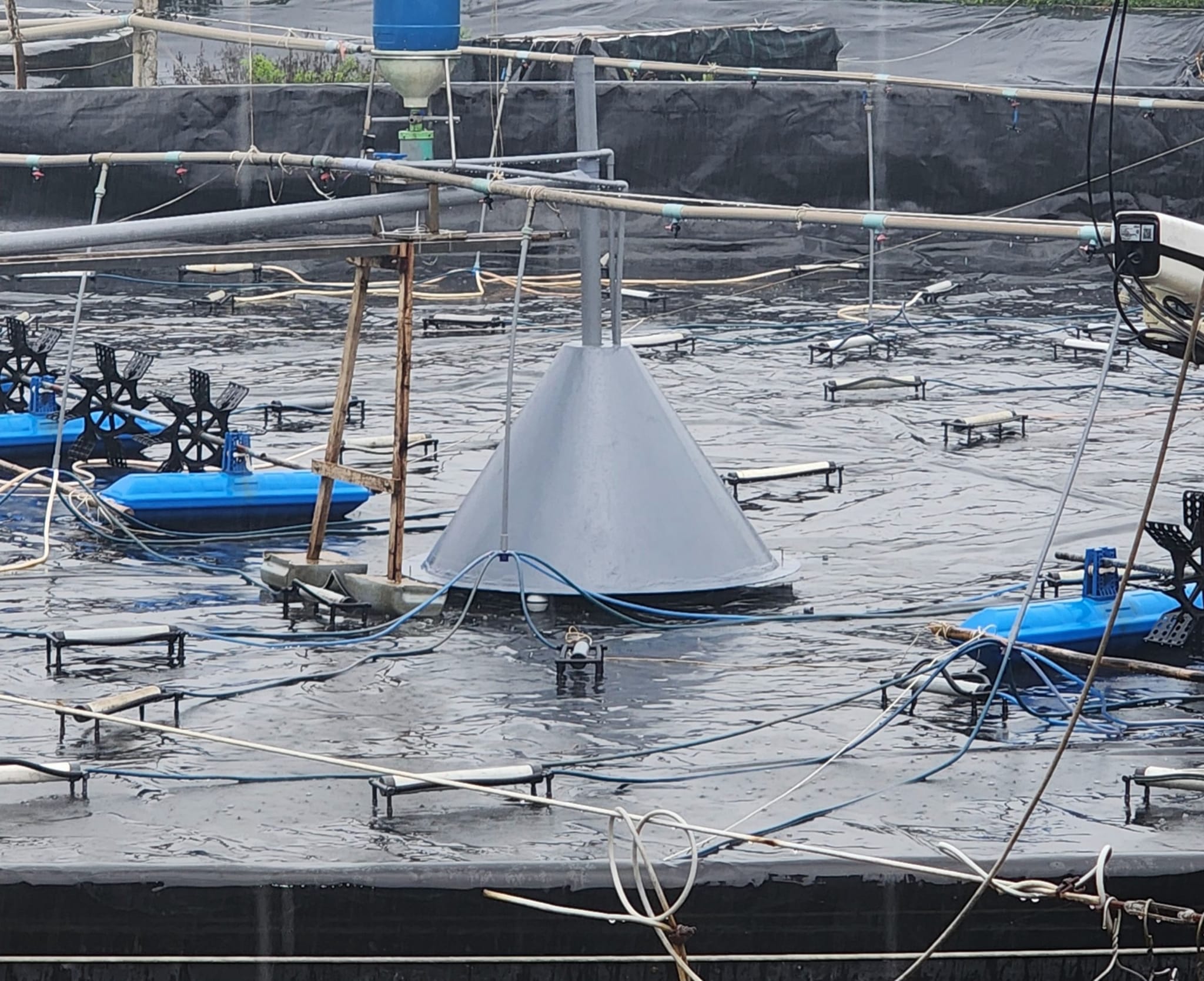
https://youtube.com/shorts/ctEgBl2LFdE
In intensive shrimp farming, fine bubbles (microbubbles, typically 20–100 µm) can significantly reduce the dependence on traditional air diffuser hoses, not because they completely replace them, but because they deliver oxygen more efficiently and improve water quality, allowing fewer diffusers to achieve the same or better results.
1. Higher Oxygen Transfer Efficiency
Fine bubbles have a much larger surface area per unit volume of air than coarse bubbles.
* More oxygen dissolves into the water before bubbles reach the surface.
* Less oxygen is wasted to the atmosphere.
* The same dissolved oxygen (DO) can often be maintained with:
* fewer diffuser hoses, or
* lower airflow.
Typical benefits include:
* 20–50% lower airflow requirement (depending on pond conditions)
* Higher oxygen utilization efficiency
* Reduced blower operating time
2. Longer Bubble Retention Time
Because fine bubbles rise much more slowly,
* oxygen remains in contact with water longer,
* oxygen dissolution continues over a greater water depth,
* dead zones become smaller.
This means a single fine bubble injector can influence a larger volume of water than a conventional diffuser outlet.
3. Better Oxygen Distribution
Traditional diffuser hoses often create:
* oxygen-rich zones near the diffuser,
* oxygen-poor areas farther away.
Fine bubbles disperse more evenly through the pond, resulting in:
* more uniform DO,
* fewer hypoxic zones,
* reduced need to install diffuser hoses throughout the pond.
4. Improved Water Circulation
When installed with venturi injectors or recirculation pumps, fine bubbles:
* create horizontal circulation,
* suspend fine organic particles,
* transport oxygen deeper into the water column.
This allows farmers to rely less on dense networks of bottom diffuser hoses.
5. Better Bottom Water Quality
Fine bubbles help:
* increase oxygen near the pond bottom,
* stimulate aerobic bacteria,
* accelerate decomposition of sludge,
* reduce anaerobic zones.
Cleaner pond bottoms decrease oxygen demand from decomposing organic matter, reducing the overall aeration requirement.
6. Reduced Blower Size
Because oxygen transfer is more efficient,
a farm may be able to use:
* a smaller blower,
* fewer air distribution pipes,
* fewer diffuser hoses.
This can reduce:
* electrical consumption,
* installation costs,
* maintenance.
7. Lower Maintenance Requirements
Traditional diffuser hoses can experience:
* clogging,
* biofilm formation,
* calcium scaling,
* uneven airflow.
Fine bubble systems based on venturi injectors generally have:
* no porous membranes,
* reduced clogging,
* lower maintenance,
* more stable long-term performance.
8. Better Shrimp Feeding Performance
Higher and more uniform DO around automatic feeders can:
* encourage shrimp to remain in the feeding area,
* increase feed intake,
* reduce stress during feeding,
* improve feed conversion ratio (FCR).
Because oxygen demand is concentrated where shrimp are feeding, fine bubbles can supply oxygen efficiently without installing many diffuser hoses around each feeder.
9. Lower Total Aeration Requirement
Cleaner water with reduced suspended organic matter and improved aerobic decomposition means:
* lower biological oxygen demand (BOD),
* lower sediment oxygen demand,
* more stable nighttime DO.
As a result, farms may require fewer operating aerators overall.
Practical Implementation
Rather than completely replacing diffuser hoses, many intensive shrimp farms adopt a hybrid aeration system:
* Paddlewheel aerators for large-scale water circulation and surface reaeration.
* Fine bubble generators positioned:
* around automatic feeders,
* near pond centers,
* in sludge accumulation areas,
* near water inlets.
* A reduced number of diffuser hoses used only where localized bottom aeration is needed.
This approach often provides better oxygen distribution while reducing energy use and maintenance.
Conclusion
Fine bubble technology enables intensive shrimp farms to reduce—but not necessarily eliminate—the use of air diffuser hoses by increasing oxygen transfer efficiency, extending bubble contact time, improving oxygen distribution, enhancing bottom-water conditions, and lowering the pond's overall oxygen demand. The greatest benefits are typically achieved when fine bubble systems are integrated with paddlewheel aerators and targeted bottom aeration, creating a more energy-efficient and stable oxygen management strategy.