with increasing pollution with many chemicals from industry and rapid
microbial growth in aquatic systems. Despite the wide availability of conventional
water and wastewater treatment methods, many limitations and challenges exist to
overcome. Applying technology based on microbubbles (MBs) and nano-bubbles (NBs)
offers ecological, fast, and cost-effective water treatment. All due to the high stability and
long lifetime of the bubbles in the water, high gas transfer efficiency, free radical generation
capacity, and large specific surface areas with interface potential of generated bubbles.
MBs and NBs-based technology are attractive solutions in various application areas to
improve existing water and wastewater treatment processes including industrial processes.
In this paper, recent progress in NBs and MBs technology in water purification and wastewater
treatment along with fundamentals, application, challenges, and future research were comperhensively discussed.
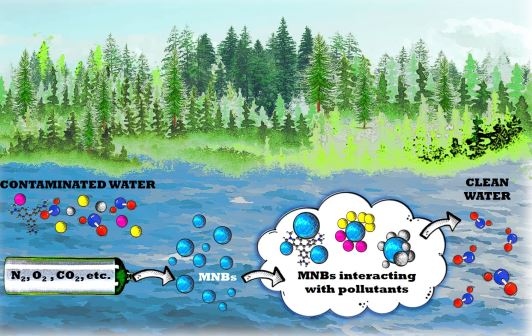
This paper provides a concise overview of the latest trends in the application of micro and nano-sized bubbles
(MNBs), covering their definition, fundamental properties, generation techniques, and their use in
wastewater treatment. Water bubbles, which are gas-filled cavities in liquid, can be classified into three size-based
categories: microbubbles, which are larger, visible bubbles that rise quickly and burst upon reaching the
surface. MBs and NBs are fine bubbles, with minimum and maximum diameters ranging from 10–100 μm, high
surface area per volume, and high Zeta potential values. These fine bubbles have unique physical properties, long
residence times in water, high oxygen transfer efficiency as well as high internal pressures making them suitable
for applications related to sanitation, wastewater treatment, and water treatment. The stability and lifespan
of MNBs are measured by the length of time they remain in solution. MNBs are produced by different mechanical
and electrochemical methods. MNBs can be effectively applied in wastewater treatment. The solubility of ozone
can be increased using MNBs in wastewater treatment. Mass transfer efficiency improves with the increase in the
solubility of ozone. Ozone-MNBs provide an efficient and cost-effective approach to wastewater treatment,
groundwater, and water reclamation. Numerous challenges and limitations for future research include
technical complexity and the high cost of generating stable MNBs, the energ