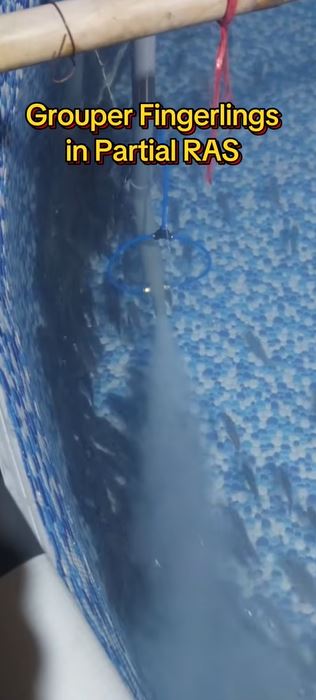
https://www.youtube.com/shorts/NWL8sUEXE4E
In a Recirculating Aquaculture System (RAS) raising grouper fingerlings at high density, dissolved oxygen (DO) management and water quality can be absolute primary bottlenecks. Grouper (such as the orange-spotted grouper Epinephelus coioides or giant grouper Epinephelus fuscoguttatus) are high-protein-fed, aggressive carnivores with high metabolic rates, making them particularly sensitive to hypoxia and ammonia spikes.
Integrating fine bubbles, microbubbles, and nanobubbles (ultrafine bubbles) into high-density grouper RAS can transform system performance across several critical dimensions:
1. Ultra-High Oxygen Transfer Efficiency (OTE)
The Problem: High-density stocking means massive biological oxygen demand (BOD) from both the fish respiration and the microbial breakdown of heavy organic waste (uneaten feed and feces). Standard coarse or medium bubble diffusers waste significant oxygen because large bubbles rise too quickly to dissolve fully, and high stocking density leaves little margin for error.
How Fine/Nanobubbles Help:
- Microbubbles (10–100 µm) have a much higher surface-area-to-volume ratio and a slower rising velocity, significantly increasing gas-liquid contact time.
- Nanobubbles (normally below 200 nm) remain suspended in water for weeks due to Brownian motion and have virtually zero buoyancy. They dissolve completely under pressure rather than escaping into the atmosphere, creating a stable, high baseline dissolved oxygen (DO) reserve (often maintaining supersaturated DO levels safely, e.g., 100–120% saturation) without creating violent turbulence that stresses fingerlings.
2. Destruction of Organic Load and Pathogen Control (Ozone/Oxygen Nanobubbles)
The Problem: High-density RAS accumulates fine suspended solids, dissolved organic carbon (DOC), and bacteria (such as Vibrio species, which are notorious for wiping out grouper fingerlings.
How Fine/Nanobubbles Help:
- When generated using pure oxygen or paired with ozone , ozone nanobubbles provide massive oxidation potential. The extremely high surface area maximizes the interaction between the oxidant and organic molecules.
- This breaks down stubborn proteins, reduces chemical oxygen demand (COD), and sterilizes opportunistic pathogens in the water column without leaving toxic chemical residues, protecting the grouper's delicate gill tissues and skin from bacterial erosion.
3. Improved Biofilter Efficiency
The Problem: Nitrifying bacteria (nitrosomonas and nitrobacter) in the moving bed biofilter (MBBR) or trickling filter require a constant, abundant supply of oxygen to convert toxic total ammonia nitrogen (TAN) into nitrite and subsequently harmless nitrate. A dip in DO rapidly crashes nitrification efficiency, causing toxic ammonia spikes.
How Fine/Nanobubbles Help: Injecting fine/nanobubbles into the water entering or circulating through the biofilter ensures that nitrifying bacteria operate at peak metabolic capacity, even under heavy feeding regimes. Furthermore, nanobubbles help prevent biofilm clogging by maintaining optimal redox conditions and preventing localized anaerobic dead zones.
4. Enhanced Flotation for Solid Removal (Protein Skimming / DAF)
The Problem: Grouper RAS generates ultra-fine suspended solids (feces and pulverized feed) that slip through standard drum filters, dissolving into nutrients that degrade water clarity and fuel algae/bacterial blooms.
How Fine/Nanobubbles Help: Fine bubbles and microbubbles are the driving force behind Dissolved Air Flotation (DAF) and advanced protein skimmers. The tiny bubbles attach to suspended micro-particles and dissolved proteins, lifting them rapidly to the surface as foam for easy removal before they can break down into toxic nitrogen compounds.