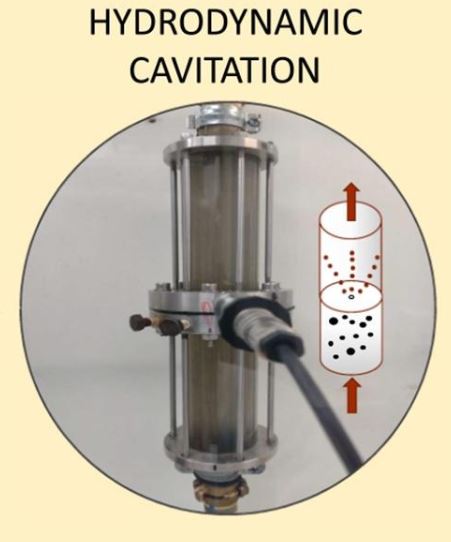
HydrodynamicCavitationasaMethodofRemovingSurfactants
fromRealCarwashWastewater
The present work aimed to evaluate whether the use of an innovative method such as
hydrodynamic cavitation (HC) is suitable for the simultaneous removal of surfactants of different
chemical natures (non-ionic, anionic and cationic) from actual car wash wastewater at different
numbers of passes through the cavitation zone and different inlet pressures. An additional novelty
was the use of multi-criteria decision support, which enabled the selection of optimal HC conditions
that maximized the removal of each group of surfactants and chemical oxygen demand (COD)
with minimal energy input. For the optimal HC variants, Fourier transform infrared spectroscopy
(FT-IR/ATR) as well as investigations of surface tension, zeta potential, specifc conductivity, system
viscosity and particle size were carried out. The highest reduction of non-ionic surfactants was found
at 5 bar inlet pressure and reached 35.5% after 120 min. The most favourable inlet pressure for the
removal of anionic surfactants was 3 bar and the removal effciency was 77.2% after 120 min, whereas
the most favourable inlet pressure for cationic surfactant removal was 3 bar, with the highest removal
of 20% after 120 min. The obtained results clearly demonstrate that HC may constitute an effective,
fast and cost-effcient method for removing surfactants from real industrial wastewater
The results obtained confrm that hydrodynamic cavitation is a promising technique
that might be applied for the simultaneous removal of different groups of surfactants
from real car wash wastewater. To select the optimal conditions for HC, the multi-criteria
decision support was used. The removal of surfactants and COD as well as energy input
were chosen as the main criteria of this evaluation. The results of the multi-criteria decision
showed that the most benefcial variants involved the inlet pressure of 3 and 5 bar. The
highest reduction of non-ionic surfactants was observed at an inlet pressure of 5 bar and
reached 35.5% after 120 min of the process. For the removal of anionic surfactants, the most
favourable inlet pressure was 3 bar and the removal effciency was 77.2% after 120 min of
the process, whereas the most favourable inlet pressure for cationic surfactant removal was
3 bar with the highest removal of 20% after 120 min. The achieved results demonstrate that
HC can be an effective and energy-effcient method for the removal of surfactants from
industrial wastewater. Future prospects are to test the suitability of other inlet pressures
and to test the suitability of HC for other industrial wastewater, the composition of which
varies depending on the production process, weather conditions or place of origin