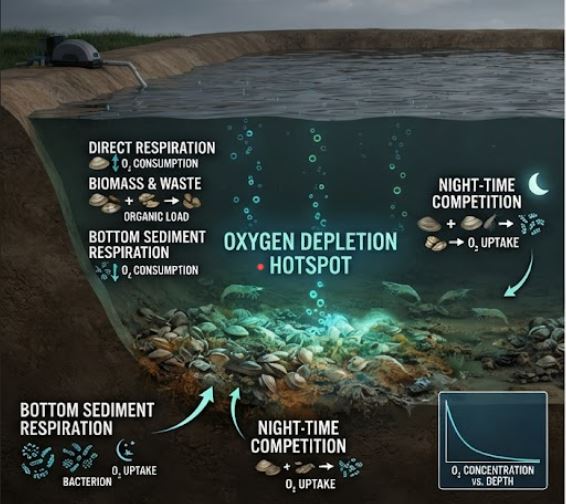
In an earthen vannamei shrimp pond, invasive shellclams can contribute significantly to oxygen consumption, especially when their biomass becomes high. Fine bubbles can help by increasing oxygen transfer and, importantly, delivering oxygen to the bottom zone where both shellclams, organic sludge, bacteria, and shrimp create high oxygen demand.
.png)
Shellclams can increase the pond's total oxygen demand through several pathways:
- Direct respiration: shellclams consume dissolved oxygen continuously.
- Additional biomass and waste: feces, dead clams and associated organic matter increase the biological oxygen demand.
- Bottom sediment respiration: bacteria decomposing organic matter consume additional O₂.
- Night-time competition: shrimp + shellclams + bacteria + other organisms all consume oxygen while photosynthesis stops.
- Algae crashes or cloudy/rainy weather: oxygen production from photosynthesis can suddenly decrease.
The problem can therefore become particularly severe near the pond bottom, where shrimp spend much of their time.
A. Higher oxygen-transfer efficiency
Fine bubbles provide a very large gas–water interfacial area.
Conceptually:
Air/O₂ → fine-bubble generator → numerous small bubbles → water → dissolved O₂
Compared with coarse bubbles, smaller bubbles generally provide:
- greater gas–water surface area;
- better oxygen-transfer efficiency;
- longer residence time in the water;
- less immediate loss of oxygen directly to the atmosphere.
If pure oxygen is used instead of air, the available oxygen transfer capacity can be increased substantially.
B. Delivering oxygen to the bottom
This is particularly important when shellclams are concentrated on the bottom.
Instead of only increasing DO near the surface:
Fine bubbles positioned near the bottom
↓
O₂ delivered directly into the bottom water
↓
Lower risk of hypoxic/anoxic zones
↓
Better oxygen availability for shrimp
This can be especially valuable during the early morning hours, when pond DO is normally at its lowest.
C. Reducing the oxygen deficit around organic sludge
A shellclam-rich pond can also accumulate considerable organic material around the bottom.
When the sediment becomes oxygen deficient:
Organic matter → anaerobic decomposition → H₂S + other reduced compounds
Fine bubbles can help maintain a more oxygenated environment in the water immediately above the sediment and support aerobic microbial decomposition.
However, an important limitation is that fine bubbles do not remove the organic load itself. If there is a thick layer of organic sludge, physical sludge removal remains necessary.
Think of the pond as an oxygen balance:
O₂ supply: photosynthesis + paddle wheels + fine bubbles
versus
O₂ consumption: shrimp + shellclams + bacteria + algae respiration + organic sediment
When shellclam biomass increases:
O₂ consumption ↑
Without additional oxygen transfer:
DO ↓ → shrimp stress → reduced feeding → possible mortality
Fine bubbles shift the balance in the opposite direction:
O₂ transfer ↑ → bottom DO becomes more stable → lower risk of oxygen crash
For a pond with shellclams, it is important to distributing fine bubbles across the pond rather than concentrating them at one location.
Fine bubbles + paddle wheels can be complementary
Paddle wheel: Strong horizontal circulation and bulk-water oxygenation
Fine bubbles: Efficient O₂ transfer and bottom oxygenation
Pure-O₂ fine bubbles: High oxygen-transfer capacity when oxygen demand is very high