An experiment at Aarup Mølle Fish Farm with support from Henrik Henriksen's Foundation has tested nanobubble technology with fish in daily operations. A parallel comparison between two ponds showed less algae growth in the pond with nanobubbles. At the same time, the biofilter became more stable, and the veterinarian's assessment did not give rise to concerns about fish welfare at the dosage used.
Nanobubble technology has been used primarily in water treatment and sewage treatment plants, but is new to aquaculture. At Aarup Mølle Dambrug, the technology was therefore tested in a functioning production facility with fish in collaboration with Biomar A/S. As far as the farm has been able to ascertain, this is the first time in Denmark that nanobubbles have been investigated in this way under practical operating conditions.
The project began in April and was carried out with support from the Henrik Henriksen Foundation. The fish farm wanted to investigate how the technology affected water quality, algae growth, biofilter, daily operations and the fish when integrated into the plant's return water.
At the end of the project, measurements, a parallel pond comparison and operating experiences all point in the same positive direction. Oxygen saturation increased in the treated return water, the fish farm registered less algae growth and cleaning needs, and the biofilter functioned more stably.
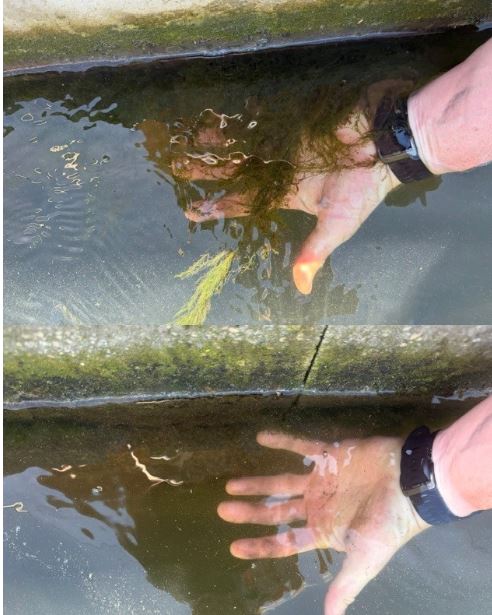
Parallel comparison between pond 3 and pond 4
When the experiment began, both pond 3 and pond 4 were empty. They were put into operation at the same time and under comparable conditions. The significant difference was that pond 3 did not receive nanobubble-treated water, while pond 4 did. Pond 3 thus served as a parallel operational reference, especially in the assessment of algal growth.
The images from the experiment are therefore not before and after images from the same pond. They show the two ponds at the same time after a simultaneous start-up. The fish farm observed clearly less algae growth in pond 4, which received nanobubble-treated water, than in pond 3 without the treatment.
From 78 to approximately 125 percent oxygen saturation
Before the installation, the return water came out of the biofilter with an oxygen saturation of approximately 78 percent and was directed to the ponds at this level. After the start-up of the nanobubble system, approximately 125 percent was measured at the inlets to ponds 4, 5, 6, 7, 8 and 9.
The nanobubbles increase oxygen saturation and act as a supplement or replacement for other methods of obtaining pure oxygen.
An oxygen saturation above 100 percent means that the water at the time of measurement contains more dissolved oxygen than the equilibrium level at the current conditions. This is not in itself the same as problematic supersaturation with total gas. The gas conditions were therefore included in the veterinary assessment of the experiment.
BioMar monitored water quality
BioMar has been involved in the project since the idea phase. Biologist Mikkel Detz has followed the trial and continuously monitored key water parameters to shed light on the technology's impact on water quality.
The measurements showed no significant changes in the other measured water parameters, while the oxygen saturation was significantly increased in the treated water volume. The results thus support that nanobubble technology under the tested conditions can be used to dissolve and distribute pure oxygen in larger volumes of water – just like other oxygenation techniques.
Less algae growth and fewer operating hours
After starting with nanobubbles, the fish farm also experienced less fouling and clogging in the biofilter, resulting in more stable biological water treatment than before.
"What is interesting for us is that the nanobubbles have not only raised the oxygen level. We have also seen less algae growth, less clogging in the biofilter and fewer hours for cleaning. The trial therefore suggests that the technology can contribute to more stable operation in several parts of the facility," says Jonas Hansen, co-owner of Aarupmølle Dambrug.
One possible explanation is the very small size of the nanobubbles. This provides a large contact surface between gas and water, and the bubbles can have a longer residence time in the water than larger bubbles. The oxygen can thus follow the return water through a larger part of the water cycle. This may have contributed to both the higher oxygen levels and the more stable function of the biofilter, but the relationship was not measured separately in the experiment.
The biofilter's bacteria depend on good and stable oxygen conditions to convert ammonium and nitrite. For Aarup Mølle Dambrug, the experiment was therefore not only about oxygen for the fish, but also about the conditions for biological water purification.
Veterinary assessment with no signs of welfare problems
Because the technology was new to the fish farm, it was not known in advance how the fish would react to the nanobubbles and the high oxygen levels. Veterinarian Thomas Clausen was therefore involved from the beginning of the project. His role included monitoring the well-being of the fish and assessing whether the technology and dosage had any negative effects.
According to the veterinarian, the general picture during the period was positive:
"The water quality was good, the fish had a good appetite, and mortality was generally low. At the concentration of nanobubbles used in the experiment, I did not find any conditions that gave rise to concerns about fish welfare or signs of problems with gas saturation," says veterinarian Thomas Clausen.
The assessment applies to the specific dosage and operation at Aarup Mølle Fish Farm. It should therefore not be readily transferred to other facilities where water chemistry, temperature, biomass, hydraulics and oxygen requirements may be different.
The technology must be adapted to the individual plant
Nanobubbles are very small gas bubbles. The small size provides a large contact surface between gas and water and can support the transfer of oxygen to the water phase. In recirculating systems, stable oxygen conditions can be relevant for both the fish and the microorganisms in the biofilter.
However, the effect depends on how the system is dimensioned and integrated. Water volume, temperature, fish biomass, recirculation rate, oxygen demand and the existing water treatment have an impact on both capacity and location. In the project, the solution was delivered by TECHRAS Nano, which was responsible for dimensioning, installation and commissioning.
Promising experiences
The trial at Aarup Mølle Fish Farm shows that nanobubble technology can be incorporated into daily operations under the tested conditions with a high and stable oxygen level. The observed simultaneous improvements in algae growth, cleaning requirements and the function of the biofilter are operationally interesting and should be included in the assessment of the technology's overall value.
The comparison between pond 3 and pond 4 provides a parallel operational reference for the observation of algal growth. However, this is still a practical experiment on one facility and not a formalized research experiment with repetitions and ongoing standardized measurement series. The other results are based on spot measurements, operational observations and a veterinary assessment.
For Aarup Mølle Dambrug, however, the conclusion of the project process is clear: During the trial period, the plant has delivered better oxygen conditions and has been associated with a more stable and less labor-intensive operation without any observed problems for fish welfare at the dosage used.