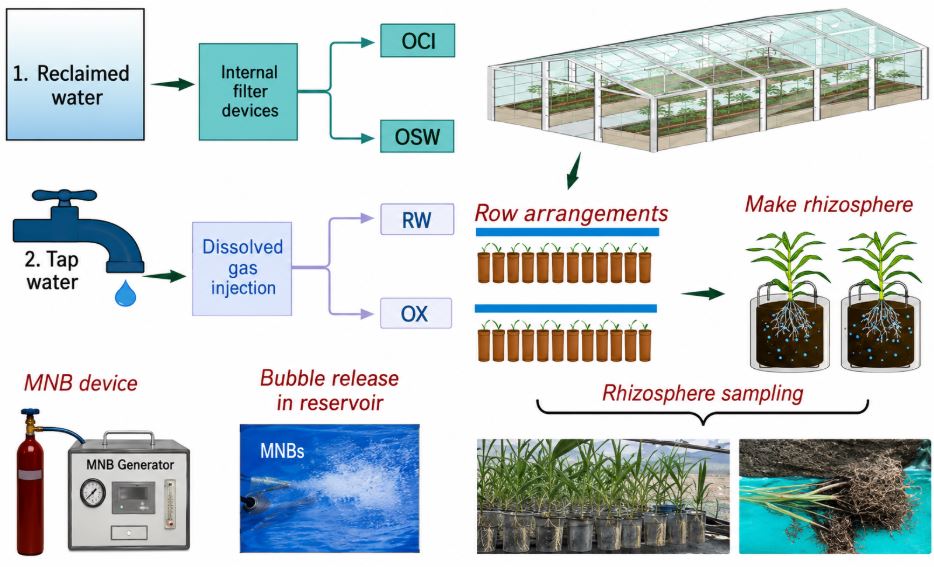
With increasing freshwater scarcity, reclaimed water has emerged as an alternative irrigation resource in agriculture. However, its influence on rhizosphere nitrogen cycling remains insufficiently understood. This study evaluated ozonated reclaimed water with micro-nanobubbles (ORW) under subsurface drip irrigation and its effects on nitrogen transformation potential in the maize rhizosphere. Ozonation increased dissolved oxygen (DO) in irrigation water from approximately 4–5 to 9–10mgL−1, improving rhizosphere aeration. Compared with the control (tap water), ORW increased nitrite reductase (NiR) activity by 1.76-fold (p<0.0001), whereas nitrate reductase (NR) activity increased by up to 51% under reclaimed water treatments (p<0.05). Soil nitrate nitrogen (NO3-N) was significantly higher under reclaimed water irrigation, with the highest accumulation observed in RW (p<0.0001), whereas ammonium nitrogen (NH4+-N) showed treatment-specific variation. Metagenomic analysis identified 59 nitrogen cycling genes, with ORW significantly increasing the relative abundance of the nitrogen fixation gene nifK (p<0.05) and enriching nitrogen-fixing taxa. Overall, ORW may serve as a sustainable irrigation strategy by potentially enhancing nitrogen transformation, increasing the abundance of nitrogen fixation–related genes and being associated with a lower potential for denitrification-driven nitrogen loss