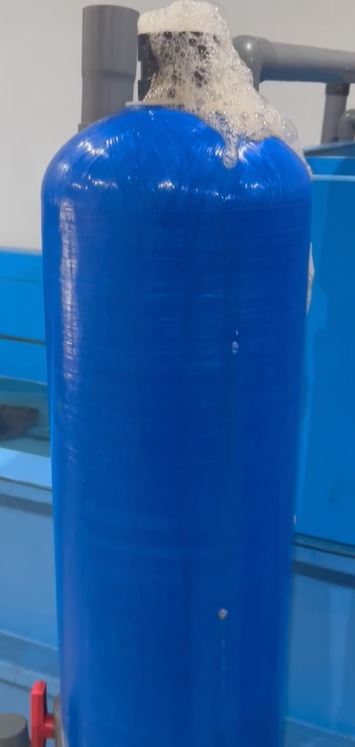
A co-current protein skimmer is particularly well suited for life-support systems (LSS) in seafood retail shops where the objective is to keep live marine animals healthy, attractive, and saleable, rather than achieving the absolute maximum organic removal efficiency. Compared with a counter-current design, a co-current skimmer is simpler, more compact, and responds quickly to fluctuating water quality—an advantage in retail environments where livestock inventory changes daily.
Key Benefits
1. Improves Water Clarity
A co-current skimmer continuously removes:
* Fish mucus
* Uneaten feed
* Dissolved proteins
* Fine suspended organic particles
* Oils from seafood handling
Benefits include:
* Crystal-clear display tanks
* Better visibility of live seafood
* More attractive presentation for customers
* Reduced yellow coloration of seawater
2. Reduces Ammonia Production
By removing dissolved organic compounds before bacteria decompose them, the skimmer:
* Lowers the organic loading on the biofilter
* Reduces ammonia generation
* Helps stabilize nitrogen cycling
* Improves overall water quality
This is especially valuable during periods of heavy customer demand when stocking density increases.
3. Maintains Higher Dissolved Oxygen
A venturi-based co-current skimmer injects millions of fine bubbles which:
* Enhance oxygen transfer
* Strip excess carbon dioxide
* Improve gas exchange
* Reduce localized oxygen depletion
Higher dissolved oxygen supports:
* Fish
* Lobsters
* Crabs
* Shrimp
* Live shellfish
during long holding periods.
4. Removes Carbon Dioxide
Continuous aeration strips dissolved CO₂, leading to:
* More stable pH
* Reduced respiratory stress
* Improved oxygen utilization
* Better animal activity
This is particularly beneficial overnight when respiration causes CO₂ accumulation.
5. Lowers Bacterial Load
Although a protein skimmer is not a sterilizer, it helps by removing:
* Bacteria attached to organic particles
* Biofilm fragments
* Organic substrates that support bacterial growth
Consequences include:
* Cleaner water
* Reduced opportunistic bacterial growth
* Lower risk of disease outbreaks
6. Supports Longer Survival of Live Seafood
Reduced stress translates into:
* Lower mortality
* Longer holding time
* Better recovery after transport
* Improved vigor
This is especially valuable for:
* Lobsters
* Mud crabs
* Live groupers
* Eels
* Octopus
* Sea snails
7. Removes Surface Foam and Oils
Seafood handling introduces:
* Fish oils
* Mucus
* Blood proteins
* Lipids
A co-current skimmer removes these compounds before they form persistent surface films, resulting in:
* Cleaner tank surfaces
* Better gas exchange
* Improved water appearance
8. Reduces Odor
By exporting dissolved organic matter before it decomposes, the skimmer helps reduce:
* Fishy odors
* Protein decay
* Organic decomposition
This creates a more pleasant shopping environment.
9. Improves Biofilter Performance
Removing organic waste before it reaches the biofilter means:
* Lower biological oxygen demand (BOD)
* Reduced clogging
* Less biofilm accumulation
* More stable nitrification
* Longer intervals between filter cleaning
10. Works Well with Ozone
A co-current venturi skimmer is an excellent ozone contactor.
When low-dose ozone is injected:
* Water becomes noticeably clearer.
* Organic compounds oxidize more efficiently.
* Foam fractionation performance improves.
* Yellow pigments are removed.
* Bacterial counts are reduced.
* Ozone residuals can be stripped before water returns to livestock tanks (with proper off-gas treatment and carbon filtration).
This combination is widely used in advanced marine life-support systems.
11. Compact and Easy to Install
Compared with large counter-current towers, co-current skimmers are typically:
* Shorter
* Smaller footprint
* Easier to integrate into existing filtration sumps
* Simpler to maintain
This is ideal for seafood retailers where equipment space is often limited.
12. Lower Operating Cost
A venturi co-current skimmer generally offers:
* No air compressor required (when using a venturi)
* Fewer moving parts
* Lower maintenance
* Lower energy consumption
* Greater reliability
These advantages reduce total operating costs while maintaining effective foam fractionation.