website: nanobubbles.jp
email: nakashima.sales@nakashimabussan.co.jp
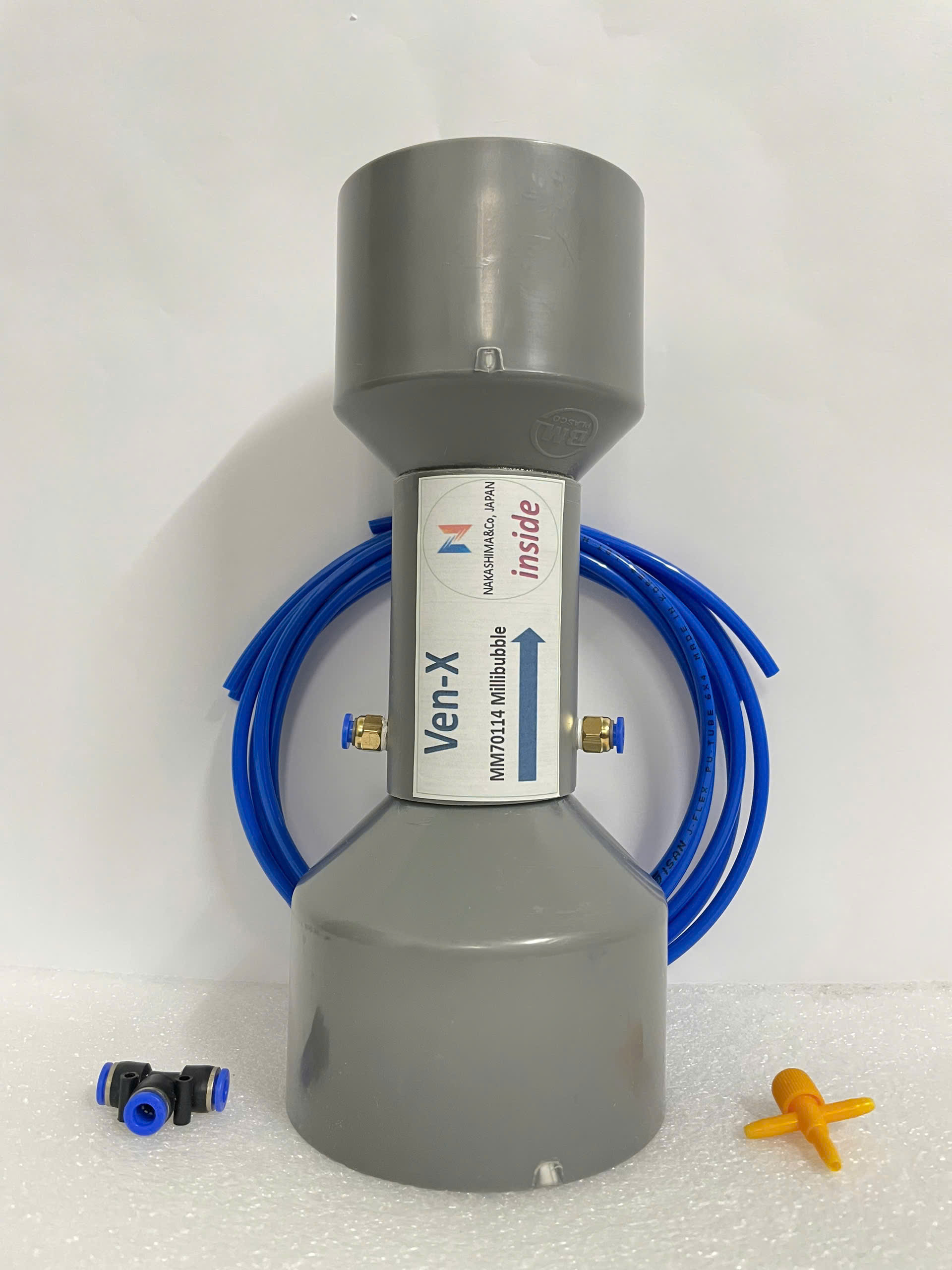
Ven X Mili-Microbubbler for prevention of hydrogen sulfide accumulation in soil pond with low water exchange
Fine bubbles can significantly support the oxidation of ferrous iron (Fe²⁺) when used together with KMnO₄ (potassium permanganate), mainly by improving gas–liquid contact, mixing, and mass transfer.
1. What happens chemically?
If the water contains ferrous iron:
*Fe²⁺ → Fe³⁺ → Fe(OH)₃(s)
The first step is oxidation of soluble Fe²⁺ to Fe³⁺. The Fe³⁺ then hydrolyzes and forms insoluble ferric hydroxide:
Fe3+ +3OH- == Fe(OH)3
The ferric hydroxide is a particulate floc that can subsequently be removed by sedimentation or filtration.
KMnO₄ is itself a strong oxidant:
MnO4- + 5Fe2+ +8H+ == Mn2+ +5Fe3+ +4H2O
So KMnO₄ provides the chemical oxidation, while fine bubbles can improve the physical conditions under which the oxidation and subsequent precipitation occur.
2. How fine bubbles help
*Fine bubbles provide several useful effects for Fe²⁺ + KMnO₄ treatment
High interfacial area : Improves gas–water mass transfer
Strong micro-mixing: Disperses KMnO₄ rapidly through the water
Better oxygen transfer: Helps maintain an oxidizing environment
Bubble-induced circulation: Keeps Fe²⁺ and oxidant in contact
Floc collision: Can help newly formed Fe(OH)₃ particles aggregate
Reduced dead zones:More uniform oxidation throughout the reactor
The important point is that fine bubbles do not replace KMnO₄. KMnO₄ is the primary chemical oxidant
3. Why combining air or O₂ fine bubbles with KMnO₄ can be useful
A practical treatment sequence could be:
*Raw water → KMnO₄ dosing → Fine-bubble contact reactor → Flocculation → Sedimentation filtration
For example:
*Raw water containing Fe²⁺
↓
*KMnO₄ injection
↓
*Fine-bubble reactor ( intensive mixing, high O₂ transfer, oxidation of remaining Fe²⁺, formation of Fe(OH)₃,)
↓
*Flocculation and contact zone
↓
*Sand : multimedia : manganese-media filter
↓
*Treated water
This can be particularly useful when the raw water has high Fe²⁺ concentration or variable iron loading, because the fine-bubble system provides continuous mixing and oxygen transfer rather than relying only on passive aeration.