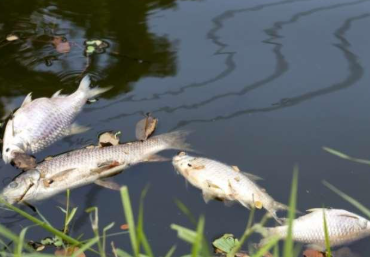
In an outdoor soil pond for fish or shrimp, rapid weather changes can trigger a chain reaction: algae instability → organic decomposition → oxygen depletion → fish/shrimp stress or mortality. Fine bubbles can act as an important buffering and emergency oxygenation tool, although they do not by themselves prevent every cause of mortality.
.png)
| Weather event | What happens in the pond | Main risk |
|---|---|---|
| Heavy rain | Cloud cover reduces photosynthesis; rainwater dilutes/changes alkalinity and salinity; pond mixing resuspends bottom sediment | Rapid DO drop, pH/salinity shock |
| Several cloudy/rainy days | Algae produce little O₂ but continue respiration | Progressive night-time DO depletion |
| Severe sunshine / heat | Algae photosynthesize strongly during daytime → very high pH and O₂ supersaturation | Large day–night DO swing |
| Sudden storm/wind | Water column and bottom sediment are mixed | Organic matter + reduced compounds enter the water |
| Algae crash | Dead algae become bacterial food | Very high BOD/oxygen consumption |
| Temperature change | Fish/shrimp metabolism and microbial activity change | Increased stress and unstable oxygen demand |
The dangerous situation is often not simply "low oxygen". It is a sequence:
Weather shock → algae instability → dead algae/organic matter → bacterial decomposition → high oxygen demand → DO collapse → animal stress → mortality
A healthy algae population is effectively an oxygen-producing system during daylight.
But when algae suddenly die:
Dead algae → bacteria decompose algae → bacteria consume O₂
At the same time, the algae themselves stop producing oxygen.
So the pond loses its O₂ supply while increasing its O₂ demand.
This can be particularly dangerous in intensive soil ponds because there may already be:
Consequently, a pond can go from apparently healthy to dangerous DO levels within hours.
Fine bubbles provide several mechanisms simultaneously.
If the fine-bubble system uses air, it continuously transfers atmospheric oxygen into the pond.
If it uses pure O₂, the oxygen-transfer potential is much greater.
The key advantage of fine bubbles is their large gas–water interfacial area.
Compared with coarse bubbles:
Smaller bubble → larger surface area per unit gas volume → longer residence time → better gas transfer.
This is especially useful when natural photosynthesis suddenly collapses.
This is one of the most important applications.
Consider a typical pond:
Daytime
Algae → photosynthesis → O₂ ↑
Night
Fish + shrimp + bacteria + algae → respiration → O₂ ↓
If the pond has already experienced cloudy weather or an algae crash, the normal daytime O₂ recovery disappears.
Fine bubbles can provide a continuous artificial oxygen source:
Fine bubbles → O₂ transfer → DO maintained → less severe pre-dawn oxygen depletion
This is particularly valuable during:
This is an important distinction.
Fine bubbles do not magically remove dead algae.
Instead, they can support the biological processes that deal with the dead organic matter.
After algae die:
Dead algae → bacterial decomposition → BOD ↑ → O₂ consumption ↑
Providing additional oxygen helps aerobic microorganisms continue decomposition without the pond becoming strongly oxygen-deficient.
This can help avoid the transition:
Aerobic → oxygen depleted → anaerobic
The anaerobic condition can subsequently produce problematic reduced compounds such as:
So the benefit is partly:
Fine bubbles → higher DO → stronger aerobic environment → less tendency toward anaerobic decomposition
Heavy rain can create a very unusual pond situation.
For example:
Heavy rain
↓
Surface cooling + dilution + mixing
↓
Algae/plankton disturbed
↓
Bottom material resuspended
↓
Organic matter enters water column
↓
Bacterial oxygen demand increases
↓
DO falls
Fine bubbles can provide oxygen exactly when this oxygen demand increases.
This is why I would view fine-bubble equipment in a soil pond not only as an "aeration system", but as a weather-shock buffer.
A useful strategy is not necessarily to replace paddlewheels completely.
Excellent for:
Excellent for:
A combined system can therefore be very effective:
Paddlewheel → circulation
Fine bubbles → oxygen transfer
Bottom circulation → prevent stagnant/low-DO zones
For high-density shrimp or fish ponds, you can go further:
O₂ generator → fine-bubble/nanobubble injector → pond
This provides an oxygen source independent of photosynthesis.
For example:
Fine bubbles operate at relatively low capacity.
Increase oxygenation before and during the event.
Increase operating hours.
Operate continuously and increase O₂ input.
Use maximum oxygen-transfer capacity.
This creates a weather-responsive oxygen management system.
In soil ponds, the bottom is often the hidden oxygen consumer.
You can have:
Water DO = acceptable
while the sediment immediately above the pond bottom is highly oxygen depleted.
Fine bubbles positioned appropriately can increase oxygen penetration into the lower water layer and improve circulation.
This is especially useful where there is:
However, aggressive bottom disturbance immediately after a storm can also resuspend reduced compounds and temporarily worsen water quality. The objective should be controlled oxygenation and circulation, not simply maximum turbulence.
A simplified oxygen curve looks like this:
DO
☀️ Afternoon
↑
↑ photosynthesis
↑
Evening
↓
↓ photosynthesis stops
↓
fish + shrimp + bacteria + algae respiration
↓
Pre-dawn — critical minimum
↓
☀️ Sunrise → photosynthesis starts again
After an algae crash, the daytime recovery may be very weak.
Therefore:
For intensive soil ponds, a three-level system can be recommended:
DO > ~5 mg/L
Heavy rain / typhoon / several cloudy days predicted
DO rapidly declining