https://jaehr.muk.ac.ir/article_75560.html
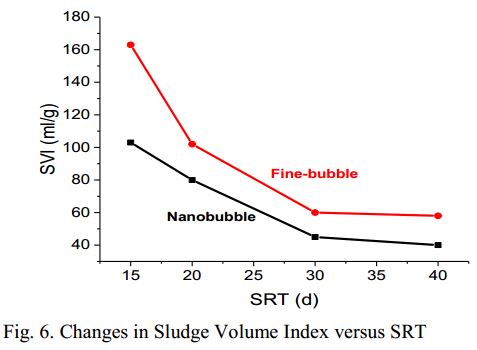
Low efficiency of conventional aeration techniques and the excessive production and disposal of sludge are great concerns in biological wastewater treatment systems. The present study aimed to evaluate the active sludge method using batch reactors under continuous operation to determine the efficiency of aeration and sludge production through microbubble and nanobubble aeration. The results indicated that compared to microbubble aeration, nanobubble aeration increased the concentration of dissolved oxygen in the mixed liqueur of the reactor (from 2 to 4.5 mg/l), while reducing the production of excess sludge from 100 to 40 ml/g (SRT: 15-40 d). With the same SRT duration, these values were within the range of 160-70 ml/g using fine-bubble aeration. According to the results, nanobubble aeration could increase the efficiency of aeration, thereby increasing the capacity of the treatment plant and reducing the costs of biological wastewater treatment
.png)
Conclusion
Based on a pilot-scale study, we investigated the effect of the size of air bubbles
(nanobubbles versus microbubbles) on the oxygen transfer energy and sludge production of
SBR. According to the obtained results, nanobubble aeration decreased the duration of
the transition zone due to the increased oxygen supply in the mixed liquor of the reactor.
However, the increase had no significant difference with microbubble aeration.
Moreover, the COD concentration (400-600 mg/l) had no visible effect on the oxygen
transfer efficiency. Nanobubble aeration significantly reduced the sludge production
compared to microbubble aeration. Mean SVI for nanobubble aeration was estimated at 150
ml/g after five hours of aeration, while it increased to 700 ml/g after the same period. In
addition, the SVI versus SRT was significantly lower in nanobubble aeration (100-40 ml/g for
15-40 d, respectively) compared to microbubble aeration (160-80 ml/g for 15-40 d, respectively).
Therefore, it could be concluded that nanobubble aeration not only increases the
oxygen transfer efficiency, but it also decreases the sludge production in SBR systems