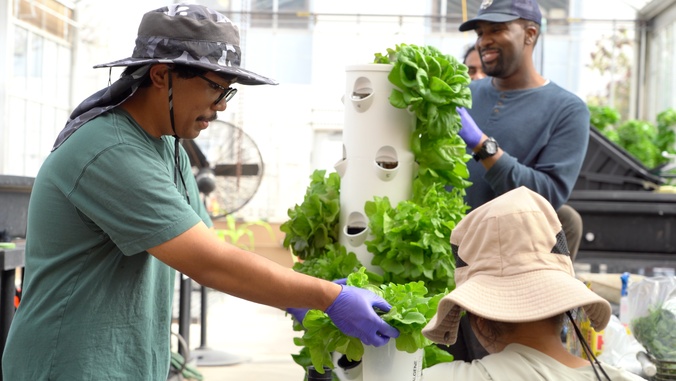
In a state where land is expensive, and the tropical heat can be a hurdle for certain crops, researchers at the University of Hawaiʻi at Mānoa’s College of Tropical Agriculture and Human Resilience (CTAHR) are looking up.
Kyle Marcelino, a PhD graduate from the Department of Molecular Biosciences and Bioengineering (MBBE) at CTAHR, conducted this research under the mentorship of Professor Samir Kumar Khanal, principal investigator, and Surendra K.C., PhD, a research scholar on Professor Khanal’s team. Together, the team is exploring new ways to strengthen local agriculture through a hybrid controlled environment system. By combining vertical farming with advanced aquaponics, they are developing a sustainable path for more commercial food production in the islands.
The tech behind the tower: Nano bubbles
At the heart of this project is the integration of nanobubble technology. Traditional aquaponic systems can struggle to maintain enough dissolved oxygen for healthy plant roots and beneficial bacteria. This system injects pure oxygen directly into the water using nanobubble technology.
CTAHR researchers are working with nanobubble technology to naturally stimulate the growth of lettuce and leafy green vegetables in growing towers.
“One of the most important parts of aquaponics is trying to maintain dissolved oxygen,” Marcelino said. This boost in oxygen serves several critical functions:
It reduces root decay or root rot caused by harmful bacteria.
It supports the natural bacteria that convert fish waste into plant-available nutrients.
It encourages bacteria to break down organic solids, preventing the buildup of sludge that can choke a system.
A system built for Hawaiʻi
With limited agricultural land available in Hawaiʻi, growing vertically offers an efficient alternative. The hybrid greenhouse system uses technology to regulate temperature, UV exposure and water quality.
Vertical farming with advanced aquaponics can be a sustainable path for commercial food production in the islands.
While the system is ideal for leafy greens, researchers are expanding their horizons to include high-value crops like strawberries that struggle in Hawaiʻi’s humidity. It can also be used for radishes and other highly nutritious root vegetables.
The ultimate goal is to help move the technology from research to commercial use, giving local farmers another tool to grow fresh food more efficiently.
“The whole big goal is to try to eventually build this controlled environment system where farmers can control temperature, water quality, and oxygen levels to grow high-value crops and feed communities,” said Marcelino.
This research is supported by the CTAHR CARES Initiative and the Mamoru and Aiko Takitani Foundation, and conducted under the leadership of Professor Khanal and K.C.