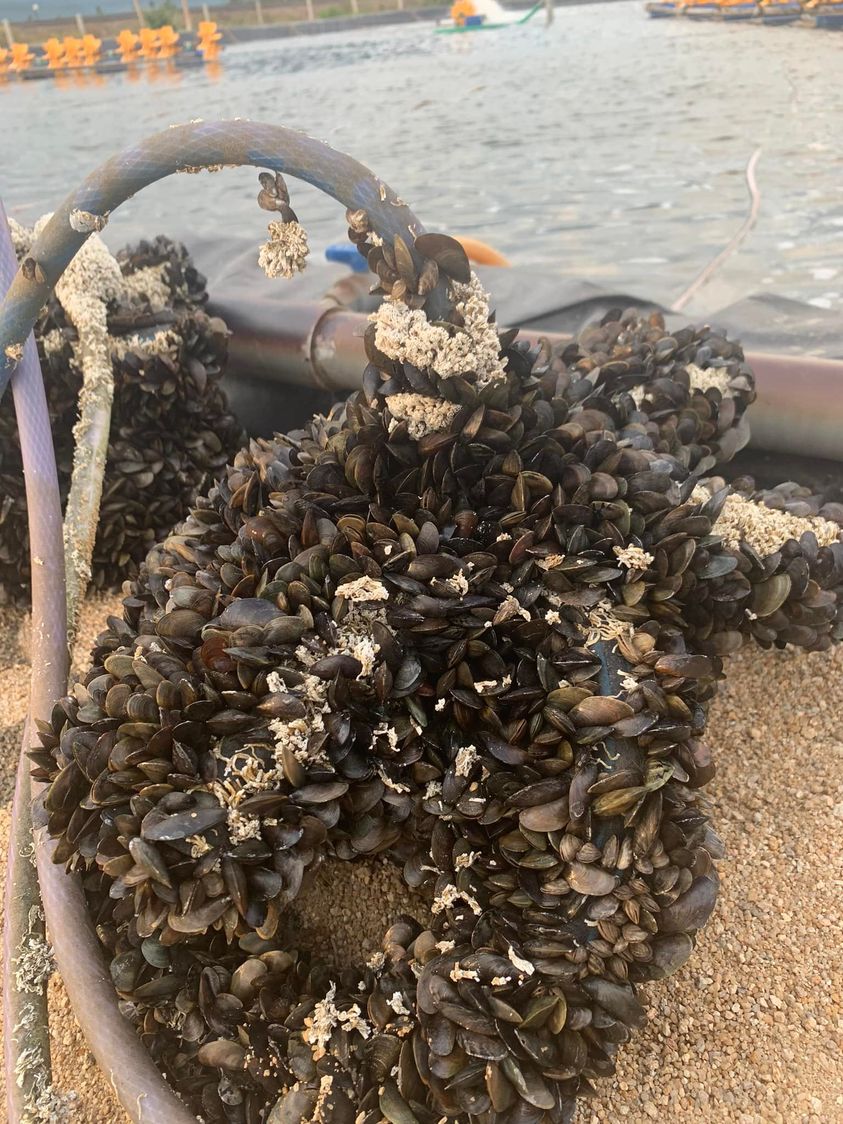
Nanobubbles help reduce usage of aerotubes which often get blocked and create fungi nests in shrimp ponds of high intensity.
- Biofilm: Bacteria and extracellular polymers form a sticky film over the pores
- Organic solids: Feces, uneaten feed, plankton and floc attach to the surface
- Mineral scaling: CaCO₃ and other minerals precipitate inside/over the pores
- Iron/manganese deposits: Particularly problematic when source water contains Fe/Mn
- Excess biofloc/TSS: Fine suspended particles progressively cover the membrane
- Algae: Algae and dead algal material accumulate on the diffuser - Low/uneven airflow: Some sections receive insufficient scouring and foul faster
In a shrimp pond of high stocking density, the organic loading around the diffuser can be very high.
For example:
Feed → shrimp → feces + dissolved organic matter + fine particles
and
Dead algae + bacterial biomass + floc → TSS
These materials are continuously transported toward aeration zones. The aerotube therefore acts almost like a particle-collection surface.
Partial blockage of aerotubes:
Suppose an aerotube initially operates at:
100% airflow → fine, uniform bubbles
After fouling:
60–70% effective pore area → higher pressure required
The blower may still be operating, but the diffuser can produce:
fewer bubbles
larger bubbles
uneven bubbling
bubbling only at certain sections
increased blower pressure
increased electrical consumption
Eventually, the aeration system can become hydraulically unbalanced, with air preferentially escaping through the least-resistance sections.
Fine bubbles can help reduce Total suspended solids in a shrimp pond by its floatation capability towards such solids. Once TSS is reduced and controlled, less chance of dissolved organic solids can stick around aerotubes.
Viscosity of culturing water is also reduced hence aeration efficiency by macrobubbles from aerotubes can also be improved.
Fine bubbled flow with its capability to sustain higher dissolved oxygen level can facilitate circular flow in a shrimp pond together with paddle wheels. This will help more even dissolved oxygen level throughout a large shrimp pond.