https://pubs.acs.org/doi/10.1021/acsestwater.6c00252
.png)
Biofilm-associated contamination represents a persistent and costly challenge across
environmental systems, causing reduced efficacy of disinfectants. Recently, nanobubbles
(NBs) have shown promise for biofilm decontamination; yet, their underpinning mode
of action remains a topic of debate. In this study, the interaction of air-generated NBs
with Escherichia coli and Staphylococcus aureus biofilms was investigated. NBs were
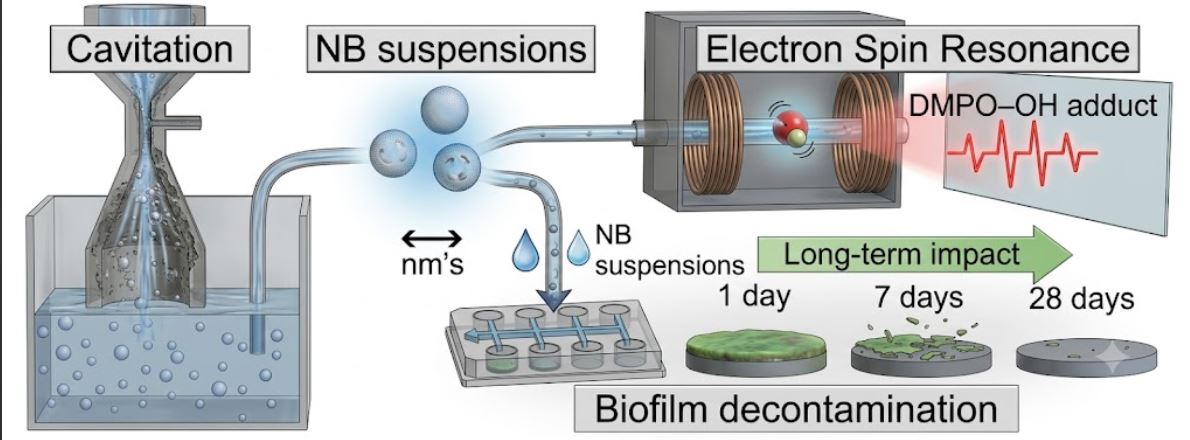
generated using a venturi nozzle and characterized using Nanoparticle Tracking
Analysis, revealing a NB density of 5.66 × 10⁸ particles/mL and a mean diameter of 84 nm.
Application of NB solution to microbial biofilms resulted in a 2.16 log reduction for E. coli
and 1.52 log reduction for S. aureus, along with visible morphological changes such as cell
collapse, wrinkling, and matrix disruption. ESR spin trapping confirmed hydroxyl radical
formation, but intracellular ROS and lipid peroxidation levels were minimal and, in some
cases, not significantly different from Milli-Q water controls. After 28 days, NBs remained
present and continued to demonstrate antimicrobial activity, biofilm disruption, and some
ROS activity. These findings indicate that although hydroxyl radicals are generated, oxidative
stress is not the dominant antimicrobial mechanism under the examined conditions, suggesting
physical biofilm disruption is the primary mode of action.
In conclusion, this study demonstrates that NBs can disrupt biofilms of E. coli and S. aureus on stainless
steel, highlighting their potential as a physical disruption strategy. NBs generated for 10 min reached
the highest stability and activity, achieving up to a 2.16 log reduction in E. coli and 1.52 log reduction
in S. aureus, compared with only around 1 log reduction for MQ water alone. While ESR confirmed
hydroxyl radical presence via DMPO-OH adduct formation in NB suspensions, intracellular oxidative
stress and lipid peroxidation assays indicated that the observed antimicrobial effects are inconsistent
with intracellular oxidative stress being the primary driver of biofilm inactivation under these conditions.
This instead suggests mechanical or physicochemical interactions at the bubble–cell interface. Ultimately,
the findings indicate that NBs could be a promising approach for biofilm disruption, offering long-lasting
antimicrobial action without the use of environmentally hazardous precursors. While the NBs examined in
this study did not achieve complete biofilm eradication, their ability to destabilize biofilm architecture
and reduce viable cell numbers without reliance on chemical oxidation positions them as an attractive
adjunct technology. In practical applications, NBs may be most effective when combined with low-dose
chemical disinfectants, enzymatic treatments, or hydraulic flushing, where physical biofilm weakening
can enhance downstream disinfection efficiency. Future work should extend this research to environmentally
relevant, mixed-species biofilms derived from natural and engineered water systems and focus on elucidating
the physicochemical mechanisms governing NB–biofilm interactions. A clearer understanding of these pathways
will support optimization of NBs for sustainable disinfection and microbial control in wastewater
treatment and water reuse applications.