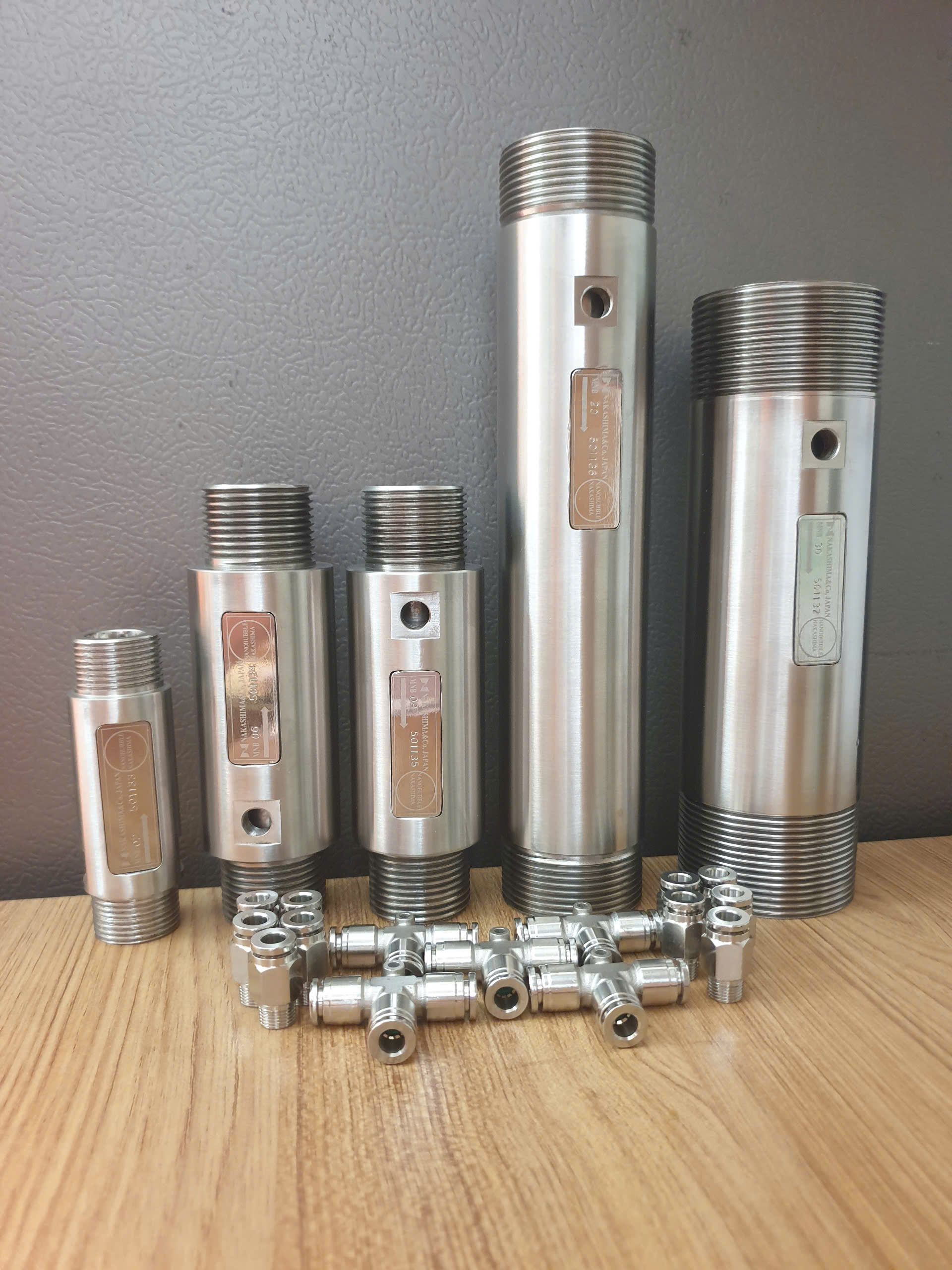
Microbubble (MB) and nanobubble (NB) generators are based on several different physical principles. Each method has different strengths in terms of bubble size, gas transfer efficiency, energy consumption, maintenance, and suitability for industrial applications such as aquaculture, wastewater treatment, hydroponics, and cleaning.
1. Hydrodynamic Cavitation (Most common for aquaculture)
This is currently the dominant commercial technology for aquaculture.
Principle
Water velocity increases dramatically.
Pressure falls below vapor pressure.
Tiny cavities form.
The cavities collapse.
Gas is broken into micro- and nanobubbles.
Typical equipment includes:
* Venturi nozzle
* Cavitation nozzle
* Multi-stage venturi
* Swirl chamber
* Vortex generator
Advantages:
* Very energy efficient
* No moving parts (venturi)
* Large water flow
* Easy maintenance
* Can inject oxygen, ozone, air, nitrogen or CO₂
Typical bubble size
* Microbubbles: 5–80 µm
* Nanobubbles: 80–300 nm (depending on recirculation and dissolution)
This technology dominates commercial shrimp farms.
---
2. Pressurized Dissolution
This is the principle used in dissolved air flotation (DAF).
Process
1. Water is pressurized (4–8 bar).
2. Gas dissolves completely.
3. Water is suddenly depressurized.
4. Dissolved gas nucleates.
5. Millions of bubbles appear.
Advantages
* Very uniform bubbles
* High oxygen transfer
* Excellent ozone dissolution
Disadvantages
* Pressure vessel
* Compressor
* Higher capital cost
Common in
* Wastewater
* Drinking water
* Industrial ozonation
---
3. Mechanical Shearing
Gas is chopped into tiny bubbles.
Methods include
* Rotor–stator
* High-speed impeller
* Turbine mixer
Advantages
* Very high gas flow
* Industrial scale
Disadvantages
* Larger bubbles
* More energy
* Wear of moving parts
---
4. Porous Membrane Diffusion
Gas passes through extremely small pores.
Bubble diameter depends on:
* pore size
* pressure
* surface tension
Advantages
* Uniform bubbles
* Quiet operation
Problems
* Fouling
* Scaling
* Membrane replacement
---
5. Ultrasonic Cavitation
High-frequency ultrasound creates microscopic cavitation bubbles.
Bubble collapse generates:
* nanobubbles
* radicals
* intense local mixing
Advantages
* Extremely small bubbles
* Excellent cleaning
Disadvantages
* Limited flow
* High electrical cost
Mostly used for:
* laboratory
* semiconductor cleaning
* medical devices
---
6. Electrolysis
Water is split into hydrogen and oxygen.
Tiny bubbles grow directly on electrodes.
Advantages
* Very pure gases
* Fine bubbles
Disadvantages
* Small production
* Electrode scaling
Mostly laboratory use.
---
7. Fluidic Oscillator
Instead of constant airflow, gas oscillates rapidly.
Oscillating gas creates repeated bubble pinch-off.
Advantages
* No moving parts
* Smaller bubbles than standard diffusers
Increasingly used in wastewater aeration.
---
8. Swirl/Vortex Bubble Generator
Water enters tangentially.
A vortex forms.
Strong shear at the gas–liquid interface tears gas into extremely fine bubbles.
Many Japanese and Korean nanobubble generators use this principle together with a venturi.
Advantages
* High oxygen transfer
* Stable nanobubbles
* Lower clogging than membranes