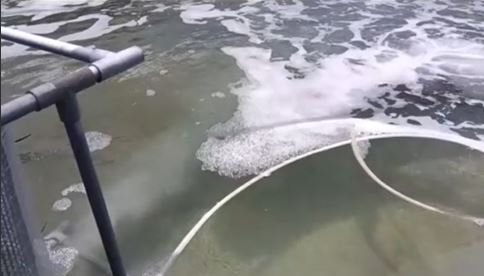
In outdoor lined shrimp ponds during cool weather (typically water temperatures of 22–28°C), using oxygen nanobubbles (ONB) together with conventional air diffusers supplied by root blowers can be highly complementary rather than competitive.
Why cool weather changes oxygen dynamics
Cool weather provides several natural advantages:
* Water holds more dissolved oxygen (DO) because oxygen solubility increases as temperature decreases.
* Shrimp metabolic oxygen demand is lower.
* Bacterial oxygen demand is also somewhat reduced.
However, intensive lined ponds often still experience:
* High nighttime oxygen demand
* Oxygen depletion near the bottom
* Uneven DO distribution
* Organic sludge accumulation
* Reduced shrimp feeding if DO fluctuates
This is where combining both systems becomes beneficial.
Role of the root blower + air diffusers
Root blowers remain the primary circulation and mixing system.
Their major benefits are:
* Maintain complete water circulation
* Prevent thermal stratification
* Suspend organic particles
* Strip unwanted gases (CO₂, NH₃)
* Produce large-scale water movement
* Create emergency oxygenation capacity
However, they have limitations:
* Oxygen transfer efficiency is typically only 5–15%
* Large bubbles escape quickly
* Much blower energy is spent moving water rather than dissolving oxygen.
Role of oxygen nanobubbles
Oxygen nanobubbles perform a different function.
Instead of creating circulation, they maximize oxygen dissolution efficiency.
Typical characteristics:
* Bubble diameter below 200 nm
* Extremely slow buoyancy
* Very high gas-liquid interfacial area
* High oxygen utilization efficiency
* Long persistence in water
The result is that oxygen enters the water much more efficiently than with coarse aeration.
Synergy between the two systems
Instead of replacing each other:
Air diffusers provide circulation.
Nanobubbles provide efficient oxygen transfer.
The combination often performs better than either technology alone.
1. Better bottom oxygen
Air diffusers create vertical circulation.
Nanobubbles are transported by these circulation currents throughout the pond.
This helps maintain oxygen near:
* pond corners
* sludge areas
* feeding trays
* shrimp resting zones
Bottom hypoxia becomes less likely.
2. Reduced blower operating time
During cool weather:
Instead of running blowers at full capacity:
Example:
Without nanobubbles
* Root blower: 24 hr/day
With nanobubbles
* Nanobubbles maintain background DO.
* Blowers operate at reduced speed or intermittent schedules.
Many farms report measurable energy savings when DO can be maintained with less blower runtime, though the exact savings depend on biomass, feeding rate, and pond design.
3. Higher DO stability overnight
Nighttime is when:
* algae consume oxygen
* bacteria consume oxygen
* shrimp continue respiration
Nanobubbles act as a dissolved oxygen reserve because they continue releasing oxygen gradually.
Instead of seeing:
DO 7 to 3.8 mg/L the pond may maintain DO 7 to 5.5–6 mg/L
This smaller fluctuation is often more important than achieving a very high daytime DO.
4. Better oxygen distribution
Large air bubbles mainly oxygenate near the diffuser.
Nanobubbles:
* travel with water currents
* remain suspended
* spread throughout the pond
This reduces localized oxygen deficiencies.
5. Less shrimp crowding
Shrimp naturally gather near:
* aerators
* diffuser lines
* water inlets
when oxygen becomes limiting.
If oxygen is distributed more evenly by nanobubbles:
* shrimp disperse more uniformly
* feeding improves
* stress decreases
* aggressive interactions may be reduced
6. Improved feed conversion
Stable DO generally supports:
* better digestion
* more active feeding
* improved feed conversion
* reduced metabolic stress
Especially when water temperatures fluctuate between day and night.
7. Better nitrification
Biofilms and nitrifying bacteria require oxygen.
Stable oxygen levels:
* improve ammonia oxidation
* improve nitrite removal
* reduce sudden spikes after heavy feeding
8. Better sludge condition
Air diffusers:
* suspend solids
Nanobubbles:
* improve oxygen penetration into sludge-water interfaces
* support aerobic microbial decomposition
This can slow the development of anaerobic zones that produce reduced compounds such as hydrogen sulfide, although nanobubbles alone cannot eliminate sludge problems.
9. Improved performance during cold fronts
After a sudden cold front:
Shrimp often:
* reduce feeding
* become less active
* remain on the pond bottom
Bottom oxygen therefore becomes especially important.
Nanobubbles can maintain:
* higher bottom DO
* less oxygen stress
* faster recovery after temperature stabilizes
10. Reduced need for pure oxygen
Because oxygen transfer efficiency increases, farms using oxygen nanobubbles often require less pure oxygen than systems relying on conventional oxygen injection alone to maintain the same DO target.