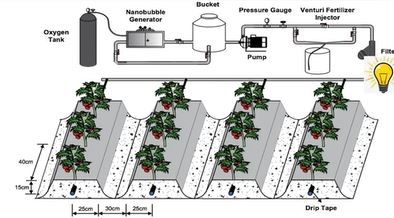
•DO concentration and MNBO application period affected tomato and cucumber yield, IWUE and fruit quality.
•MNBO application improved soil quality by increasing rhizosphere soil enzyme contents and soil microbial species.
•15 mg/L and the fruiting stage were the optimal DO concentration and application period of MNBO for tomato and cucumber.
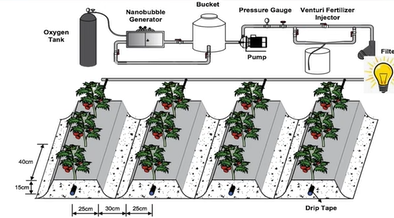
Micro-nano bubble water oxygation (MNBO) has been recognized an effective way to increase crop yield and quality, but the effects and potential mechanism of dissolved oxygen (DO) concentration and application period on crops are unknown yet. Consequently, experiments within two consecutive growing seasons were conducted to determine the effects of two MNBO application period (SF: seeding and flowering stage, FR: fruiting stage) and two DO concentration (15 mg/L and 25 mg/L) on the yield, IWUE, fruit quality of tomato and cucumber as well as the soil quality under two kinds of water source (RW: reclaimed water, GW: groundwater). The results indicated that application of MNBO resulted into higher yield and IWUE of tomato and cucumber compared to no-oxygation treatments (CK) and RW irrigation showed higher production than GW treatments. Significant differences on fruit quality (p < 0.05) were recorded between MNBO application at FR and CK, particularly for vitamin C for two crops and tomato lycopene. DO15 was more effective on yield and quality improvement than DO25. Additionally, MNBO application improved soil quality by increasing rhizosphere soil urease and phosphatase contents and soil microbial species, which promised to stimulate crop root growth and accumulate soil available nutrients. Comprehensive consideration of IWUE, yield and quality, DO15_FR was recommended as the optimal MNBO pattern for greenhouse tomato and cucumber.
Conclusions
The current study clearly demonstrated that MNBO application periods and DO concentrations had effects on crop productivity and fruit quality. The fruiting stage and 15 mg/L were the optimal MNBO application period and DO concentration for tomato and cucumber, and there was an upper threshold of DO concentration for MNBO application. RW_DO15_FR yielded highest production in the study, with 40.88% and 69.12% higher yield and VC for tomato compared with no-oxygation treatment, and those were