Oxygenated Nanobubbles as a Sustainable Strategy to Strengthen Plant Health in Controlled Environment Agriculture
https://www.mdpi.com/2071-1050/17/12/5275
Controlled Environment Agriculture (CEA) offers a protected system
for agricultural production; however, it remains vulnerable to diseases,
particularly root diseases such as Pythium root rot and Fusarium wilt.
Sustainable and eco-friendly agricultural practices using plant-beneficial
microbes can help mitigate these harmful diseases. These microbes
produce natural antibiotics and promote induced systemic resistance (ISR),
which enhances nutrient uptake, stress tolerance, and disease resistance.
While plant-beneficial microbes have been applied in conventional cropping
systems, they have yet to be fully integrated into CEA-based systems.
Oxygen availability in the root zone is critical for the functionalities of beneficial
microorganisms. Insufficient levels of dissolved oxygen (DO) can hinder
microbial activity, lead to the accumulation of harmful compounds, and cause
stress to the plants. Contemporary aeration technologies, such as novel
oxygenated nanobubble (ONB) technology, provide better oxygen distribution
and promote optimal microbial proliferation, enhancing plant resilience.
Hydroponic and soilless substrate-based systems of CEA production have
significant potential to integrate beneficial microbes, increase crop yields,
prevent diseases, and improve resource use efficiency. This review aims
to summarize the significance of DO and the potential impact of novel ONB
technology in CEA for managing root zone diseases while increasing crop
productivity and sustainability.
Sustainable irrigation systems are necessary to efficiently utilize water
resources in agriculture, particularly for CEA, including soilless substrates
and hydroponic systems. One of the most significant attributes of ONBs is
their capacity to lower the surface tension of water, allowing them to penetrate
deep in soil or soilless substrates, resulting in improved infiltration to the root
zone where it is most needed. ONBs may enhance root respiration, nutrient
absorption, and aerobic microbial activity, improving plant health for increased
growth and yields [27,72]. Moreover, ONBs possess the potential to enhance
water use efficiency and nutrient uptake, as their tiny size and high surface
area permit improved water entry and distribution within the root zone.
Nonetheless, implementing ONB technology presents challenges, including
cost-effectiveness and scalability in CEA operations. Furthermore, the long-term
crop-specific effects of these technologies in CEA, especially for soilless
substrates and hydroponic systems, on plant health and microbial community
dynamics require further investigation.
ONB technologies demonstrate significant progress in CEA production,
especially in hydroponic cultivation, where plant roots are immersed in nutritional
solutions, requiring aeration to maintain enough oxygen levels for enhanced
productivity. ONBs may raise oxygen availability in the root zone, enhance plant
physiological performance, optimize nutrient uptake, and improve water use
efficiency, thereby promoting overall plant health. Furthermore, integrating ONBs
with beneficial microorganisms in the root zone enhances plant resistance under
stress-prone growth settings, notably in CEA, where many root-zone diseases can
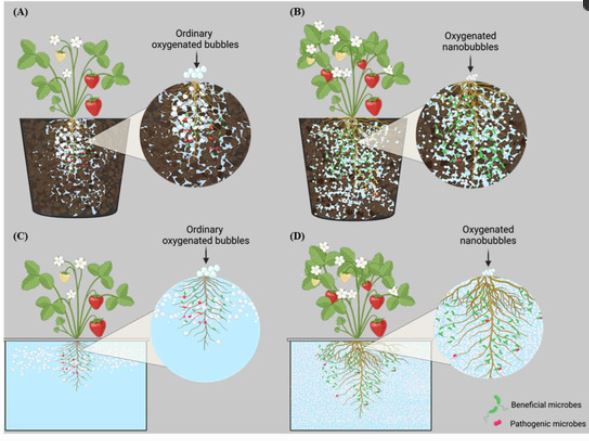
emerge and cause significant yield losses. Improved plant health, achieved through
sustained optimal oxygen levels, will foster the growth of beneficial microbes that
bolster plant immunity (Figure 2) and synergistically enhance CEA production.
By adopting this approach, we can develop sustainable biobased management
strategies to address root zone diseases in CEA and beyond.