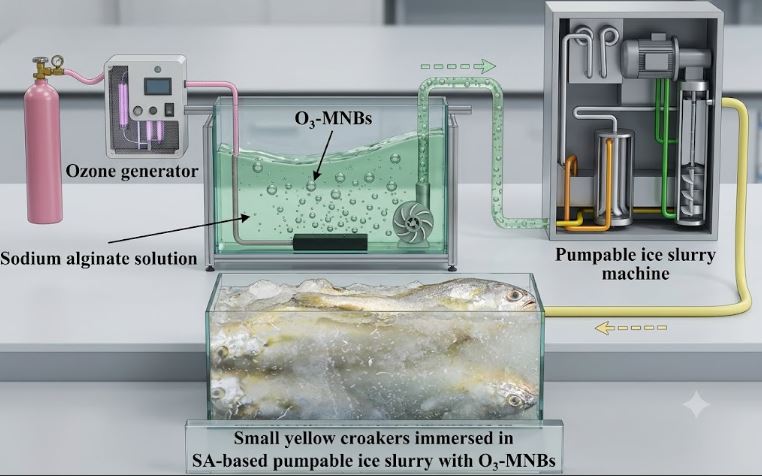
a novel strategy for accelerating the production of pumpable ice slurry (PIS) by using ozone micro–nano bubbles (O3-MNBs) was proposed. The effect of PIS containing sodium alginate (SA) and O3-MNBs on the preservation of small yellow croaker (Larimichthys polyactis) was investigated. The results indicate that using SA solution containing O3-MNBs instead of only SA solution resulted in quicker production of PIS by promoting ice nucleation and eliminating supercooling. The distribution and positive effect of O3-MNBs as a nucleation agent on freezing characteristics were discussed. Microbial concentrations, pH, total volatile basic nitrogen, and thiobarbituric acid reactive substance content were also examined. Storage in novel PIS (containing O3-MNBs) had higher performance than storage in flake ice or conventional PIS due to the strong bacteriostatic ability of O3. Therefore, O3-MNBs injection can be used as a novel method for PIS production and the preservation of fresh marine products.
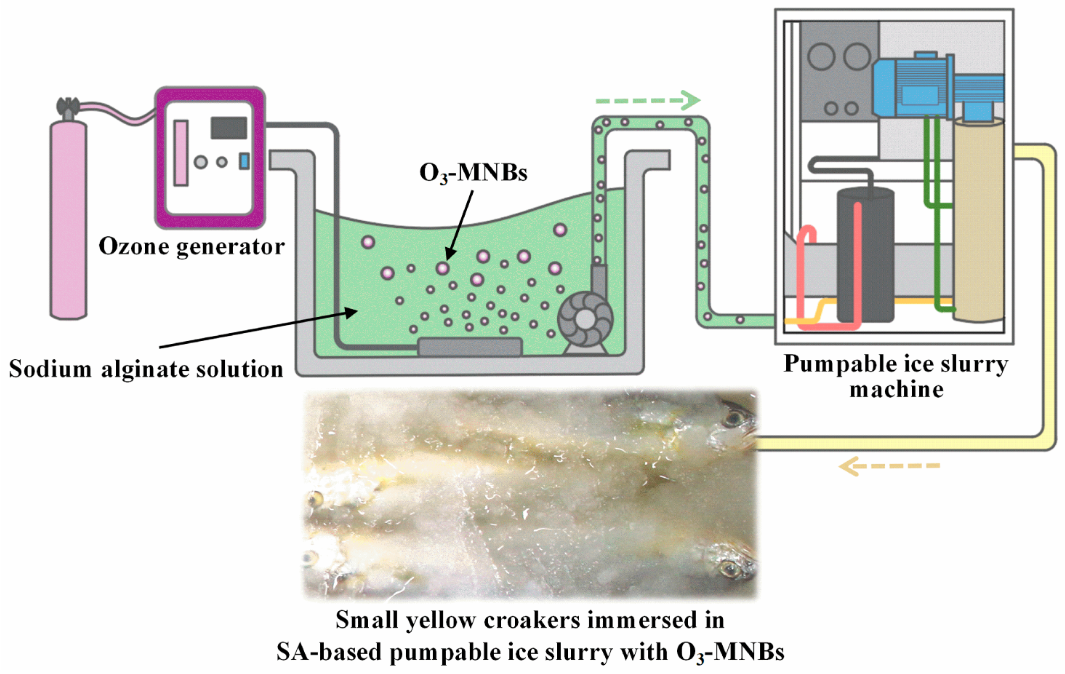
In this study, the effect of O3-MNBs on the production of PIS was investigated. Additionally, a series of microbial and biochemical parameters were also employed to determine whether O3-MNBs combined with PIS are effective for the preservation of small yellow croaker. The results indicate that the injection of O3-MNBs eliminated the supercooling effect observed during the production of PIS and shortened its total freezing time over 7.7%. Because each bubble is generally regarded as a potential nucleation site during the production of PIS, the SA solutions with more O3-MNBs had a higher nucleation rate, thereby resulting in a shorter freezing time. The relationship between bubble distribution and freezing characteristics was also discussed. In addition, our results indicate that the injection of O3-MNBs has positive effects on fish preservation, such as maintaining bacterial count and pH and TVB-N. However, it is worth noting that the injection of O3-MNBs would increase the fat oxidation of the fish samples (TBARS content up to 4.59 mg MDA/kg at the end of storage). Therefore, more types of PIS combined with antimicrobial compounds should be developed in the future.

