.png)
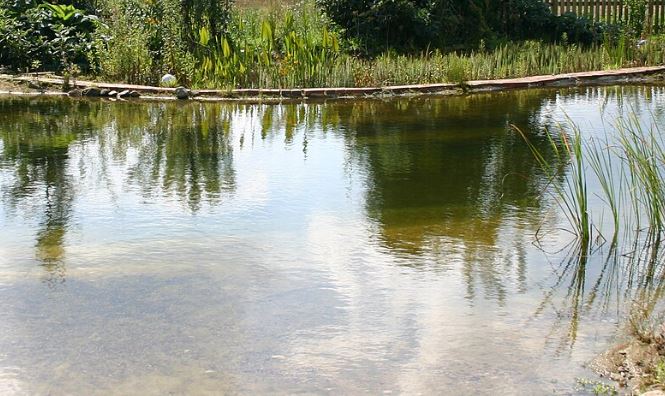
A wetland swimming pool—also called a natural pool or eco-pool—combines a clean swimming area with an adjoining wetland regeneration zone. Water moves slowly through gravel, plant roots, and helpful microbes to clean itself naturally. This system keeps water clear and soft without using harsh chemicals like chlorine.
Pathogens, coliforms, or parasites surviving the natural biological filtration may come back to swimming zone. Sanitation or disinfection is then required to ensure safe and clean swimming water.
Ozone is a strong oxidizer and disinfectant; if injected upstream of the wetland, dissolved ozone or active hydroxyl radicals will destroy the beneficial biofilm and roots in the wetland bed.
The optimal layout requires placing the ozone nanobubble section DOWNSTREAM of the wetland, immediately before water returns to the swimming zone.
The Wetland's Role: Constructed wetlands rely on living biofilms (nitrifying/denitrifying bacteria on gravel/root surfaces) to break down organic matter and absorb excess nutrients like ammonia and nitrates.
The Ozone Risk: Active ozone (O3) and hydroxyl radicals (-OH) inactivate microorganisms via cell-wall oxidation. Injecting ozone prior to the wetland would sterilize the bio-bed, killing beneficial bacteria and scorching plant root systems.
Place the ozone nanobubble unit on a sidestream injection loop directly after water exits the wetland outlet/collection basin.
Disinfection: Any pathogens, coliforms, or parasites surviving the natural biological filtration are destroyed at this step before water re-enters the swim zone.
Nutrient Inactivation: Residual dissolved ozone oxidizes any trace organic compounds or fine colloidal particles released by plant matter in the wetland.
When ozone nanobubbles collapse and react, they rapidly convert into pure dissolved oxygen (DO).
Retaining water in high-DO states directly as it returns to the swimming basin keeps the main body of water clean, ultra-clear, and resistant to algae growth without needing excess chemicals or disturbing the upstream biological wetland.
Sediment/Skimmer Pre-filter: Traps coarse debris and leaves before the wetland bed to prevent physical clogging.
Subsurface-Flow Wetland Bed: Slow, natural bio-filtration through gravel media and aquatic plant roots.
Wetland Clearwell / Storage Tank: Collects biologically treated effluent water.
Sidestream Ozone Nanobubble Loop: A booster pump draws clear water from the clearwell/wetland discharge, passes it through the nanobubble generator, and reinjects the hyper-oxygenated, sanitized stream back into the main return pipe.
Main Pool Inlets: Enters the main swimming zone fully polished, disinfected, and enriched with micro/nanobubbles.