https://www.sciencedirect.com/science/article/abs/pii/S2213343725023334
higher than conventional ozone.
Nanobubbles’ mass transfer coefficient was one order
of magnitude higher than conventional ozone.
Nanobubbles are detectable in solution at 39 °C
after 4 h without additional gas infusion.
Nanobubbles clean acrylic and PVC surfaces up to
2.4 times better than conventional ozone and tap water
Nanobubbles enhance gas–liquid mass transfer, particularly in gas-limited
or diffusion-restricted systems, owing to their minuscule sizes and high
interfacial surface areas. However, their potential to enhance ozone mass
transfer in heated aqueous systems for removing abiotic fouling in sanitary
applications remains understudied. This study simulated application
conditions for a typical sanitary system to evaluate ozone nanobubbles’
efficacy for surface cleaning. First, 71 × 106 nanobubbles/mL were produced
by circulating 120 L of tap water at 39 °C with 0.5 LPM ozone-air flow rate
(target ozone = 1.5 mg/min) for 2 h. This resulted in a dissolved ozone
concentration of 5.6 µg/L i.e., 2.7 times higher than the conventional ozone
(micro-macrobubble). Ozone nanobubbles exhibited a more rapid increase
in oxidation-reduction potential and dissolved oxygen than conventional ozone.
Although dissolved ozone was depleted within 1 h, 12 × 106 nanobubbles/mL
remained in suspension after 4 h. The minimal decline in ORP over this period
suggests that the residual nanobubbles continued to release ozone and/or oxygen
, sustaining the oxidative environment in the absence of external ozone input.
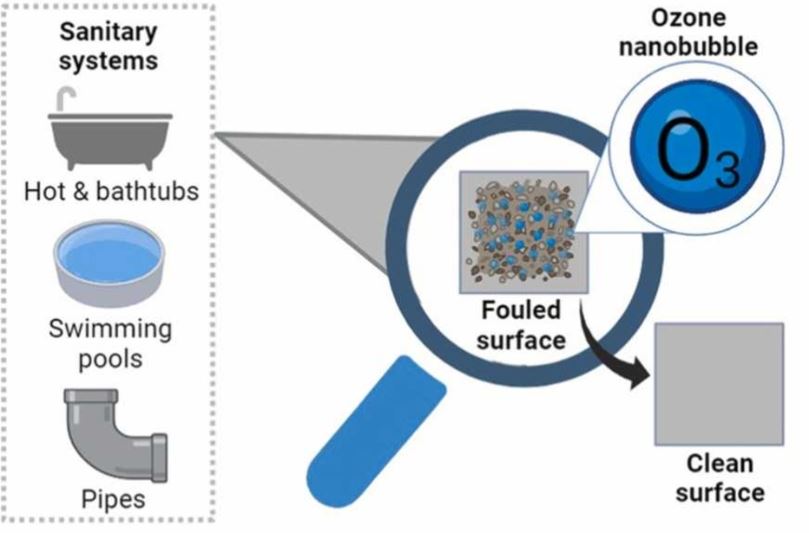
Nanobubbles significantly enhanced fouling removal by up to a 2.4-fold on PVC
and acrylic surfaces than conventional ozone solutions within a 30-minute treatment
period. SEM, FTIR, and XRF analyses expounded the role of enhanced ozone transfer
by nanobubbles in improving surface cleaning, and also revealed potential surface
interactions between ozone and polymer substrates. The findings here feature the
potential of ozone nanobubbles to enhance cleaning performance in sanitary systems,
offering an effective solution for fouling control.