https://www.mdpi.com/2073-4395/13/12/2917
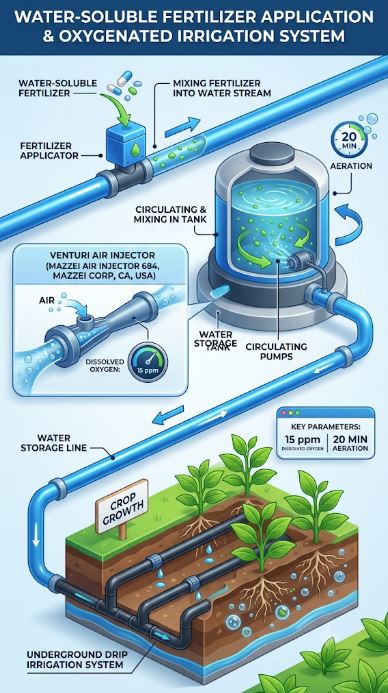
Nano-bubble irrigation, as a new irrigation technology, can deliver fertilizer-mixed oxygenenriched water to the root zone of crops, representing a new means for increasing crop yield and carbon sequestration and emission reduction. To systematically analyze the effects of nano-bubble
irrigation on crop yield, soil aeration, and soil greenhouse gas (GHG) emissions, as well as evaluating its contribution to the net greenhouse warming potential (NGWP) in greenhouse agriculture, this study was conducted in greenhouse facilities in Zhengzhou, China and focused on tomato plants.
A 2-factor, 2-level, completely randomized trial of nitrogen application (low N1: 120 kg/hm2 and normal N2: 180 kg/hm2), conventional irrigation, and nano-bubble irrigation (C: 5 ppm and A: 15 ppm) was conducted. Compared with conventional irrigation, crop yield increased by 18.94%
and 16.36% (p < 0.05), CO2 emission by 10.72% and 5.71% (p < 0.05), N2O emission by 29.76% and 35.74% (p < 0.05), and CH4 uptake by 300.67% and 327.67% (p < 0.05) under nano-bubble irrigation.
The nano-bubble irrigation increased the crop yield, thus significantly improving the NGWP sink for greenhouse gases. The low-nitrogen and regular-nitrogen treatments increased NGWP by 22.69% and 14.52%, respectively (p < 0.05). This suggests that nano-bubble irrigation can significantly improve soil
aeration, increase tomato yield and biomass, and significantly improve crop carbon sequestration. In the future, nano-bubble irrigation can be used along with soil amendments to achieve a more efficient increase in yield and enhance the ability of farmland to sequester carbon and reduce emissions.
(1) Nano-bubble irrigation has been shown to improve water use efficiency and nutrient uptake in crops, resulting in a significant increase in crop yield. Compared to conventional methods, nano-bubble irrigation led to an 18.94% and 16.36% increase in yield (p < 0.05) under low and normal nitrogen conditions, respectively. Additionally, this new technology enhanced nitrogen use efficiency (NUE) by 7.28% and 1.53% (p < 0.05) and increased partial fertilizer productivity (PFP) by 19.39% and 17.05% (p < 0.05), respectively, under the same conditions.
(2) The influence of a single factor, such as nitrogen application rate or air addition, had an extremely significant effect on yield (p < 0.01). However, the interaction
between the nitrogen application rate and nano-bubble irrigation did not have a significant effect on yield but showed a significant effect on PFP (p < 0.05) under
multiple factor interactions.
(3) In greenhouses, tomato soil under nano-bubble irrigation acts as both a source of CO2 and N2O emissions and an absorption sink of CH4. The greenhouse effect was found to be influenced in the order of CO2 > N2O > CH4, with the greenhouse farmland ecosystem serving as a sink for greenhouse gases. Compared to conventional irrigation, nano-bubble irrigation increased the net global greenhouse potential (NGWP) values under low and normal nitrogen conditions by 22.69% and 14.52%, respectively (p < 0.05).
(4) By combining nano-bubble irrigation with organic amendments, it is possible to achieve increased crop yield, carbon sequestration, and emissions reduction, thus improving the practicality and applicability of this novel irrigation technology.
In conclusion, nano-bubble irrigation has a positive impact on crop yield, water and fertilizer utilization efficiencies, and carbon sequestration in the greenhouse farmland ecosystem.

